


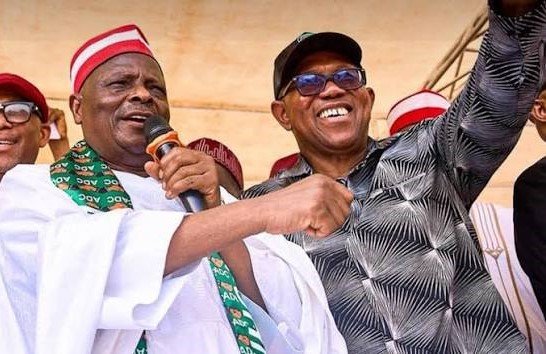
A new political clash has emerged between the New Nigeria People’s Party (NNPP) and the Nigeria Democratic Congress (NDC) over a proposed Peter Obi–Rabiu Musa Kwankwaso presidential ticket ahead of the 2027 general election.

The NNPP has accused some of its former leaders of attempting to dismantle the party’s structure in favor of supporting an Obi-Kwankwaso presidential bid on the NDC platform. The NDC quickly dismissed this allegation, calling it unfounded and politically driven.
This exchange follows closely on the heels of NNPP’s denial of reports suggesting it had entered a secret agreement with the NDC to back an Obi-Kwankwaso ticket. The party clarified that its decision to nominate a placeholder presidential candidate was solely to align with the Independent National Electoral Commission (INEC) timetable, allowing room for future political negotiations.
NNPP National Chairman Major Agbo, in an interview, claimed that the party’s recent past leadership, led by Bala Yusuf, had planned to merge the NNPP into the NDC to support what he referred to as the “O-K arrangement.”
Agbo stated that the former leadership aimed to hand over the party’s structure to bolster the political ambitions of former Kano State Governor Rabiu Kwankwaso, who recently joined the NDC.
Agbo emphasized that the current NNPP leadership has rejected any plan to collaborate with Kwankwaso or his associates, maintaining the party’s independence while remaining open to strategic alliances that align with its constitution and manifesto.
He explained that the party nominated a placeholder for presidential candidacy merely to meet INEC’s deadline but is open to substituting the candidate if a stronger one becomes available.
He reiterated that although the NNPP is open to alliances, it has no plans to engage in any arrangement involving Kwankwaso.
In response to these allegations, NDC Deputy National Publicity Secretary Abdulmumin Abdulsalam dismissed the claims, stating that there is no agreement with the NNPP and that the NDC is not seeking political partnerships.
He noted that the NDC currently enjoys sufficient political momentum and sees no need for negotiations with the NNPP.
Abdulsalam argued that Kwankwaso and his supporters have already moved beyond the NNPP, describing the party as part of Kwankwaso’s past political journey.
This renewed exchange highlights the increasing political realignments leading up to the 2027 elections as opposition parties reposition themselves to challenge the ruling All Progressives Congress (APC).
With more alliances and defections expected in the coming months, political analysts suggest that despite repeated public denials of behind-the-scenes negotiations, the opposition landscape remains fluid.