







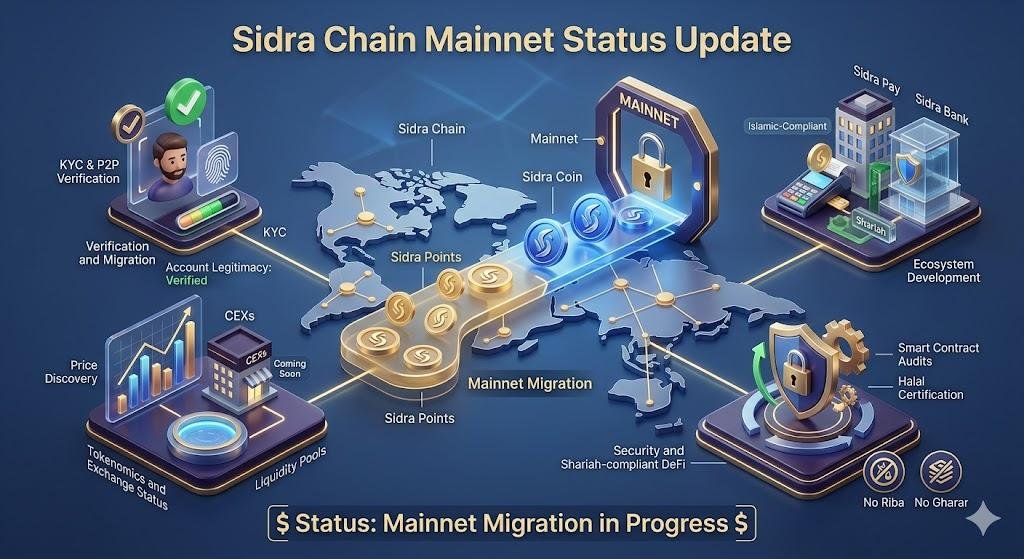
Sidra Chain continues to attract attention from cryptocurrency users as the blockchain project moves through an important phase of its development, with activity surrounding Mainnet transition, SDA migration, KYC verification and ecosystem expansion.
As of August 19, 2026, Sidra Chain’s public blockchain ledger continues to record transactions, including transactions confirmed today. This provides evidence that the network remains active on-chain.
At the same time, recent reports circulating around the Sidra community indicate that Mainnet transition and SDA migration are active, while P2P KYC verification and project onboarding continue to progress. These claims should nevertheless be distinguished from independently verified information because not all social-media accounts discussing Sidra Chain are official.
Sidra Chain remains active on its blockchain
One of the clearest developments that can be independently checked is activity on the Sidra Chain ledger.
The network’s public Blockscout explorer continues to show recently confirmed transactions. Several transactions were recorded during August 2026, including activity within the last few days and transactions crawled today.
This is important because blockchain activity provides a more concrete indicator of network operation than social-media posts alone.
For Sidra users, the continued appearance of confirmed transactions suggests that the underlying chain remains operational and accessible through its public ledger.
Mainnet transition and SDA migration
The biggest subject of discussion among Sidra users in August is the reported Mainnet transition and SDA migration.
Recent posts circulating online state that the Mainnet transition and SDA migration are live, with P2P KYC verification and project onboarding continuing.
However, users should be careful when interpreting such posts.
A social-media announcement should not automatically be regarded as an official Sidra Chain announcement unless it originates from a verified official channel.
The distinction matters because cryptocurrency communities frequently encounter impersonation accounts, unofficial token contracts and misleading claims about listings or migration deadlines.
KYC remains a major issue for Sidra users
Know Your Customer, commonly known as KYC, remains one of the most important issues for the Sidra community.
Sidra Chain has historically required identity verification as part of participation in its ecosystem, and recent community updates indicate continuing progress around P2P verification.
A properly functioning KYC system can help blockchain networks reduce duplicate accounts, fraudulent identities and automated abuse.
For Sidra Chain, successful verification could also become increasingly important as the network moves toward greater Mainnet activity and wider ecosystem participation.
Users who have accounts showing “Pending” or “Verification in Review” should rely on official Sidra communication channels for instructions rather than paying third parties who promise to accelerate verification. Recent social-media posts have referenced these verification statuses, although they should be independently confirmed before being treated as official guidance.
What about the SDA token?
The Sidra Digital Asset (SDA) remains at the centre of the project’s ecosystem.
One of the major questions among users is when SDA will become broadly tradable on established cryptocurrency exchanges.
Recent reporting indicates that SDA has not been broadly listed on major exchanges such as Binance, Coinbase, CoinMarketCap or CoinGecko, and users should be particularly careful because unrelated tokens using similar “Sidra” names may exist.
This is an important warning.
A token appearing on a decentralized exchange or an unofficial trading platform does not automatically mean it is the official SDA issued by Sidra Chain.
Before purchasing any token claiming to represent Sidra, users should verify the official contract address and the source of the listing.
Is Sidra Chain already a real blockchain?
Yes, there is verifiable evidence of an operational blockchain ledger associated with Sidra Chain.
The network has a public blockchain explorer, and recent blocks and transactions continue to be visible.
The Sidra Chain application is also described on Google Play as the official app for participating in network validation events and using the Sidra wallet.
However, being an operational blockchain is different from having a widely liquid, publicly traded token.
These are two separate milestones.
Why exchange listing remains important
For many Sidra users, exchange listing is the next major milestone they are waiting for.
A major exchange listing could potentially increase accessibility and liquidity for SDA, but listing decisions are controlled by individual exchanges and normally depend on factors such as regulatory requirements, technical integration, liquidity, security and due diligence.
There have also been reports suggesting that Sidra’s team is waiting for regulatory approval before broader listing activity.
Therefore, claims that SDA will definitely list on a particular exchange on a particular date should be treated as unconfirmed unless the exchange itself announces the listing.
Sidra Chain’s focus on the GCC
Another theme surrounding Sidra Chain’s 2026 strategy is expansion toward the Gulf Cooperation Council (GCC) market.
Some reports describe the project as positioning itself around Sharia-aligned blockchain infrastructure and potential expansion into Gulf markets.
This could become strategically important if Sidra succeeds in establishing partnerships and real-world applications in financial and commercial markets.
However, potential expansion should not be confused with confirmed adoption.
The important indicators will be actual partnerships, applications, transactions and regulatory approvals.
What Sidra users should watch next
There are several developments that could determine Sidra Chain’s next stage.
1. SDA migration
Users should watch for clear official instructions concerning SDA migration, eligibility and wallet requirements.
2. KYC verification
P2P KYC and pending verification cases remain important to users seeking full participation in the ecosystem.
3. Mainnet development
Continued blockchain activity and development of Mainnet infrastructure will remain critical.
4. Exchange listing
A confirmed listing on a major exchange would be a significant milestone, but users should wait for official confirmation.
5. Sidra DEX and ecosystem applications
Decentralized exchange infrastructure, liquidity and applications could eventually provide additional utility for SDA.
What is the SDA price today?
This question requires particular caution.
There are online pages displaying prices for assets named “Sidra Chain” or “SIDRA,” but these may represent unrelated tokens rather than the official Sidra Digital Asset.
For example, Coinbase currently displays a very low-priced asset called “sidra chain” on the Base network, but the page itself identifies a Base contract address. That should not automatically be interpreted as the official Sidra Chain SDA token.
Therefore, publishing a specific “SDA price today” without confirming the exact official asset could mislead readers.
For a news publication, it is safer to state that there is no broadly established major-exchange price for official SDA that can be confidently presented as the definitive market price today.
Beware of fake Sidra tokens and websites
As interest in Sidra Chain grows, users should be especially careful about scams.
Fake tokens can copy a project’s name, logo and branding.
Fraudulent websites may also ask users to connect wallets, enter private keys, provide seed phrases or send cryptocurrency.
No legitimate platform should require a user to reveal a private wallet seed phrase.
Sidra users should therefore verify websites and announcements through official Sidra channels before connecting a wallet or transferring funds.
The bigger picture for Sidra Chain
Sidra Chain appears to be moving into a more important phase of its development.
The network has an active public ledger, while the current community discussion is increasingly focused on Mainnet, SDA migration, KYC, project onboarding and potential exchange accessibility.
The project’s next challenge is to convert its growing community into genuine economic activity.
That means more than mining or holding SDA.
The long-term test will be whether Sidra can build useful applications, attract developers, establish legitimate partnerships, create liquidity and provide real-world utility for its digital asset.
Sidra Chain remains active in August 2026, with blockchain transactions continuing to appear on its public ledger and the community focused heavily on Mainnet transition, SDA migration and KYC progress.
As of August 19, 2026, however, there is no sufficiently verified evidence of a major official announcement released specifically today that would justify claiming a confirmed major exchange listing or a specific SDA price.
For Sidra users, the most important developments to watch are therefore official migration instructions, KYC progress, Mainnet development, legitimate ecosystem projects and verified exchange announcements.
The Sidra story is moving into a potentially important stage—but the project’s ultimate success will depend on whether its technology and digital asset can develop real utility, real adoption and sustainable economic activity.
For now, Sidra users should stay patient, verify every announcement and avoid unofficial SDA tokens, fake websites and guaranteed-price claims.