







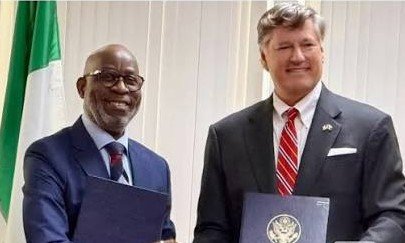
Nigeria and the United States have signed a framework agreement aimed at attracting greater American investment into Nigeria’s mining sector and developing the country’s mineral resources.
The agreement was signed on Wednesday in New York by Nigeria’s Minister of Solid Minerals Development, Dele Alake, and US Deputy Secretary of State Christopher Landau on the sidelines of the 81st United Nations General Assembly.
Nigeria estimates the value of its mineral resources at about $700 billion, according to the Federal Government.
Framework covers mining and processing
The agreement is designed to provide a foundation for cooperation between both countries across the mining value chain.
According to Alake, the framework covers geological data and exploration, mineral development and processing, infrastructure, and technical capacity building.
The arrangement is also expected to use government-to-government relations as a foundation for business-to-business transactions and investment partnerships.
Alake said Nigeria wants to move beyond exporting raw minerals and retain more value from its natural resources through domestic processing.
“Nigeria cannot remain a source of raw materials while others capture most of the value. We want more local processing, quality jobs, stronger skills and greater opportunities for Nigerian businesses,” he said.
Critical minerals attract global interest
The agreement comes as countries seek to strengthen supply chains for critical minerals used in technologies including electric vehicle batteries and renewable energy infrastructure.
Nigeria has deposits of several minerals, including lithium, gold, tin, iron ore, gemstones and phosphate.
Lithium has attracted particular attention because of its importance to battery production and the global transition toward lower-carbon energy.
Reuters reported that Chinese companies have been among the active foreign investors in Nigeria’s emerging lithium sector.
Nigeria seeks more local value
Alake said the objective is not simply to increase mineral exports but to develop activities that create more economic value inside Nigeria.
He said the government would work with US partners to identify viable projects and turn the framework into specific investments and commercial partnerships.
“Now comes the harder and more important work: moving from agreement to implementation,” Alake said, according to the Federal Ministry of Information.
US pledges deeper cooperation
Landau said the agreement reflected the United States’ interest in strengthening its partnership with Nigeria.
“The signal we are sending is that the United States and Nigeria are partners,” he said.
The agreement comes amid broader US efforts to strengthen relationships with mineral-producing countries and diversify critical-mineral supply chains.
For Nigeria, the framework forms part of efforts to attract foreign capital into the mining industry and reduce dependence on oil.
The next stage will involve identifying projects, mobilizing investment and developing partnerships under the framework.