






You can find articles, reports, expert opinions, research papers, social media posts and advice about almost any subject within seconds.
But having more information does not necessarily mean having more understanding.
The real challenge is often figuring out:
- What does all this information mean?
- Which ideas agree?
- Where do they conflict?
- What patterns appear across different sources?
- How are seemingly unrelated ideas connected?
This is where synthesis becomes important.
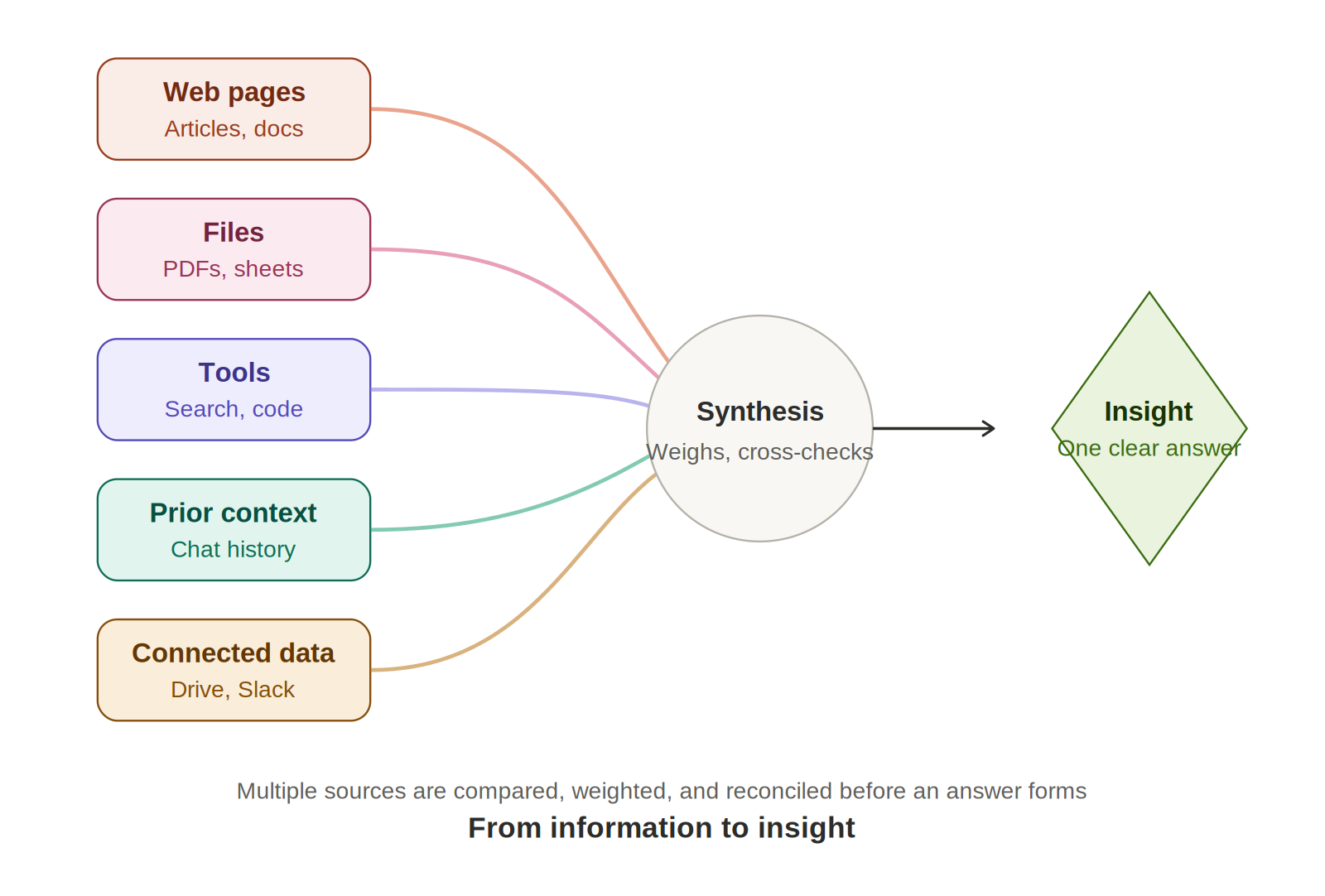
Instead of asking Claude to summarize one source at a time, you can give it multiple sources and ask it to reason across them.
The goal is to move from information to insight.
What Is Synthesis?
A summary tells you what a source says.
Synthesis goes a step further.
It asks:
“What do these sources mean when we look at them together?”
For example, imagine you are researching why people experience fatigue.
You find several articles:
- One discusses sleep
- Another focuses on nutrition
- A third examines exercise
- Another discusses stress
Reading each article separately might give you four different explanations.
But if you provide all four sources to Claude and ask it to identify the connections, you may discover a broader pattern.
The sources might approach the problem from different directions while still pointing toward a common theme.
That is synthesis.
Scenario: Conflicting Health Advice
Imagine you have been feeling tired and want to understand possible reasons.
You search online and find different explanations.
One article says you may need more sleep.
Another suggests your diet could be responsible.
A third emphasizes physical activity.
Another focuses on stress.
All of the articles sound convincing, but they do not appear to agree.
You could read everything repeatedly and take detailed notes.
Or you could give the relevant sources to Claude and ask it to compare them.
For example:
“Read these four sources together. Identify where they agree, where they disagree, and what broader patterns or explanations emerge across all of them.”
Claude can then organize the information into a more useful picture.
Important Health Note
For health questions, AI-generated synthesis should not be treated as a diagnosis or a substitute for medical advice. Persistent or concerning symptoms should be discussed with a qualified healthcare professional.
Summary vs. Synthesis
This distinction is essential.
A Summary
A summary might tell you:
“The first article argues that insufficient sleep can contribute to fatigue.”
Then:
“The second article discusses how nutritional deficiencies can affect energy.”
Then:
“The third article explains the role of exercise.”
Each statement describes one source.
A Synthesis
A synthesis asks what the three sources reveal together.
For example:
“Although the articles focus on different causes, they all examine factors that can affect the body’s ability to maintain energy and recover effectively.”
The second response is more than a collection of summaries.
It identifies the relationship between the ideas.
The Secret Is Asking the Right Question
One of the most important lessons is that your prompt determines what Claude looks for.
If you ask:
“Summarize these three articles.”
Claude will probably produce three summaries.
If you ask:
“How do these three articles connect? Identify common themes, disagreements, supporting evidence and important differences.”
You are directing Claude toward relationships.
That changes the task from summarization to synthesis.
Useful Synthesis Questions
When working with multiple sources, try questions such as:
- What ideas do these sources have in common?
- Where do they disagree?
- What assumptions does each source make?
- What evidence supports each position?
- Are there contradictions between the sources?
- What broader pattern emerges?
- Which conclusions are strongly supported?
- What important information is missing?
- What unexpected connections can you identify?
These questions encourage deeper analysis.
How You Package Information Matters
Another important skill is source organization.
If you give Claude one article today, another article tomorrow and a third article several days later without maintaining context, it becomes more difficult to compare everything consistently.
Instead, provide the relevant materials together whenever practical.
Clearly separate them.
For example:
SOURCE 1 — Sleep Research
[Text or document]
SOURCE 2 — Nutrition Research
[Text or document]
SOURCE 3 — Exercise Research
[Text or document]
Then tell Claude exactly what you want it to compare.
This gives the AI a clearer information environment in which to identify relationships.
When You Don’t Understand a Concept
Synthesis is not only useful for comparing sources.
Claude can also help you understand unfamiliar concepts.
Imagine you are reading an article about stress and repeatedly encounter the term:
“Cortisol dysregulation.”
You may know that cortisol is associated with the body’s stress response, but the word “dysregulation” may still be confusing.
Instead of simply asking for a dictionary definition, ask Claude to explain the concept using examples and contrasts.
For example:
“Explain cortisol dysregulation in simple language. Compare what normal regulation means with what dysregulation could mean, using everyday examples. Avoid unnecessary medical jargon.”
This approach can make complicated ideas easier to understand.
Learn Through Contrasts
One of the most effective ways to understand a difficult concept is to compare it with something familiar.
You can ask Claude to explain:
- What it is
- What it is not
- What it looks like in practice
- What the opposite looks like
- How it differs from a similar concept
For example:
“Explain this concept to me as if I were a beginner. Then give me three examples, three non-examples and one comparison with a similar concept.”
This creates multiple angles for understanding.
The Ultimate Test of Understanding
There is a simple test for whether an explanation worked:
Can you explain the idea to someone else?
If you cannot, ask Claude to try again.
You could say:
“Explain this again using a simpler example.”
Or:
“Explain it without technical terminology.”
Or:
“Teach it to me as if I were a beginner, then ask me three questions to check whether I understand it.”
A good explanation should leave you capable of using the concept yourself.
Extracting the Big Ideas From Long Reports
Claude can also be useful when dealing with long reports.
Imagine you receive a 50-page workplace wellness report.
You could ask for a basic summary.
But you can obtain more value by asking Claude to identify the report’s most important insights.
For example:
“Read the entire report and identify the five most important findings for a business leader. Explain why each finding matters and identify the evidence supporting it.”
A strong synthesis might reveal ideas such as:
- Wellness initiatives are more effective when integrated into normal workplace structures.
- Mental health support can be more effective when organizations take proactive steps.
- Leadership participation may matter more than simply increasing program spending.
These conclusions may not appear together in one section of the report.
Claude’s job is to connect the evidence and identify the broader message.
Finding Unexpected Connections
Some of the most valuable insights emerge when sources do not obviously belong together.
Imagine you are researching fatigue.
You have several health-related articles.
Then you remember reading something about:
Productivity systems and decision fatigue.
At first, these subjects appear unrelated.
But you can ask Claude:
“Compare these health articles with this material on productivity and decision fatigue. Are there any meaningful connections between the concepts? Separate strong connections from speculative ones.”
This distinction is important.
Claude should not simply invent a connection because you asked for one.
A strong synthesis should explain why the connection exists and what evidence supports it.
From Information to a Knowledge Map
When you combine multiple sources, you can ask Claude to organize the information into a knowledge map.
For example:
Sources → Key Ideas → Common Themes → Differences → Connections → Implications
This creates a structured pathway from raw information to understanding.
You can also ask Claude to identify:
- Main arguments
- Supporting evidence
- Contradictions
- Gaps
- Assumptions
- Implications
- Open questions
This is particularly useful for research, business analysis and complex decision-making.
A Practical Synthesis Prompt
Here is a reusable prompt structure:
“Analyze all the sources provided together rather than summarizing them separately. Identify the main ideas in each source, then compare their arguments, evidence, assumptions and conclusions. Identify areas of agreement and disagreement. Look for connections or patterns that emerge only when the sources are considered together. Distinguish well-supported conclusions from uncertain or speculative interpretations. Finally, explain the most important insights I should take away.”
This prompt encourages Claude to move from summary to synthesis.
What You Just Learned
The key lesson is that information and insight are not the same thing.
Information tells you what individual sources contain.
Insight emerges when you understand how those pieces fit together.
Claude can help with that process by:
- Comparing multiple sources
- Identifying common themes
- Finding contradictions
- Explaining difficult concepts
- Connecting seemingly unrelated ideas
- Extracting important findings from long documents
- Tracing relationships between ideas
- Separating strong conclusions from speculation
The most important question is no longer simply:
“What does this source say?”
Instead, ask:
“What do all these sources mean when I consider them together?”
That is the shift from information to insight.
Final Takeaway
The real power of AI-assisted research is not simply producing more summaries.
It is helping you make sense of information.
When you give Claude multiple sources and ask it to compare, connect and reason across them, you create the opportunity for insights that may not be visible in any individual document.
In other words:
Summarization tells you what you have.
Synthesis helps you understand what it means.
And when you can understand what the information means, you are much better positioned to make informed decisions.