






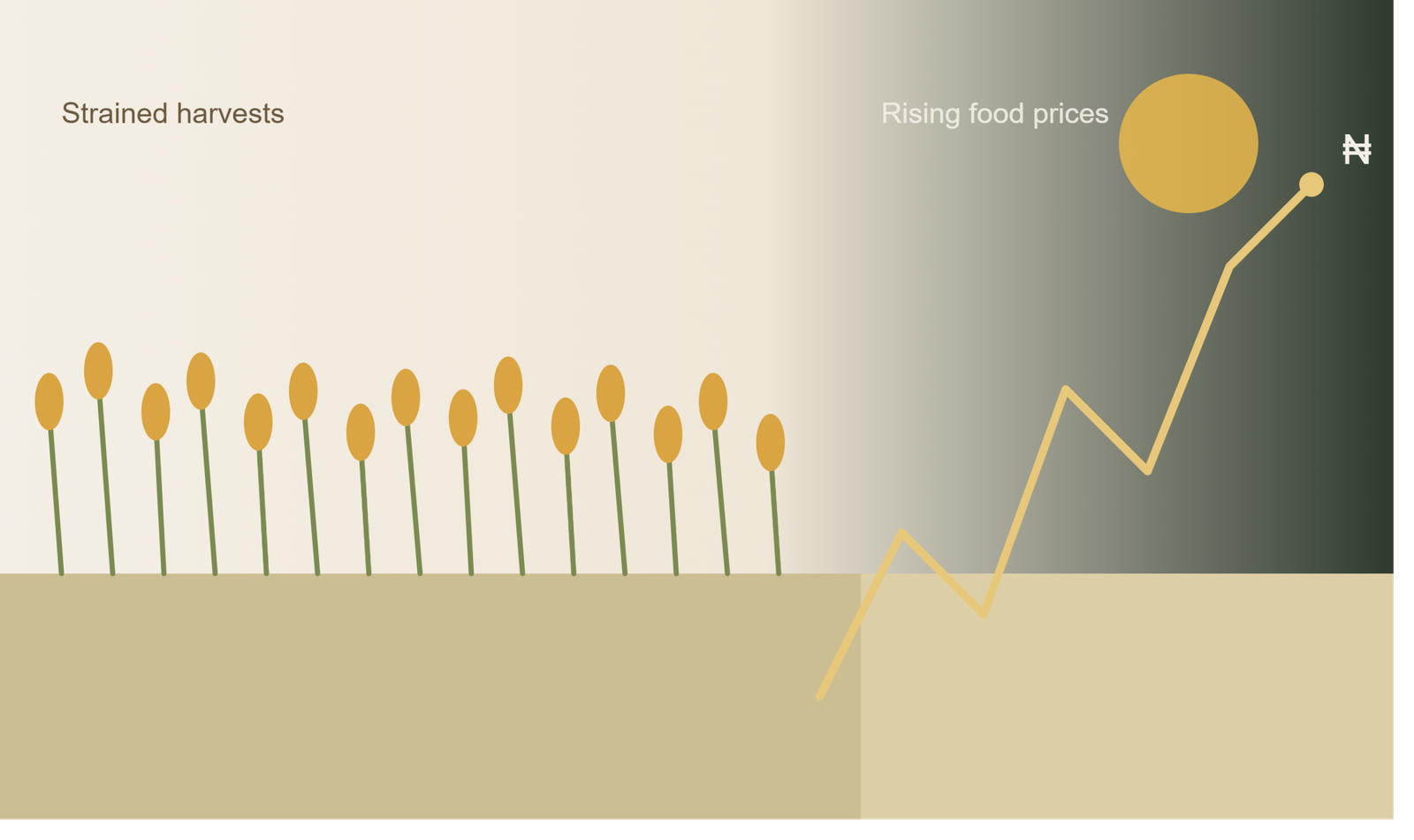
Nigeria’s persistent food production challenges remain a major factor behind the country’s struggle to achieve sustained price stability, with farmers and consumers facing a combination of structural, security and logistical problems.
The challenges affecting agricultural production are multifaceted. They include limited access to mechanisation, insecurity in farming communities, expensive financing, inadequate irrigation systems and insufficient access to improved seeds and other agricultural inputs.
Poor rural feeder roads, unreliable electricity, inadequate storage facilities and limited access to markets have also continued to weaken the agricultural value chain.
Recent economic assessments support concerns about the strong link between food supply and inflation in Nigeria. The International Monetary Fund said food remains a major driver of inflation, while transport costs and other supply-side pressures continue to influence prices. The IMF also noted that about one-quarter of retail food prices can reflect transportation costs.
The problem is particularly evident in the movement of food from producing communities to major consumption centres.
Food may be available in states such as Kebbi, Zamfara and Benue, particularly in rural farming communities, but getting agricultural produce from farms to markets remains a major challenge. Moving food from surplus-producing areas to regions experiencing shortages can also be expensive and inefficient.
Insecurity has further complicated the situation by disrupting farming activities and forcing some farmers away from their fields. The impact is reflected not only in reduced production but also in higher costs associated with transporting agricultural goods.
Agricultural sector assessments have identified insecurity, rising input costs, climate change, post-harvest losses, low mechanisation and irrigation, and weak transportation infrastructure among the major constraints limiting Nigeria’s agricultural potential.
Transportation costs are particularly important because food often travels long distances before reaching consumers. Higher fuel and haulage costs can therefore substantially increase the final price paid by households.
The IMF has also warned that higher food and transport costs continue to weigh on economic activity and household welfare.
Government Focuses on Agricultural Investment
The Federal Government has identified several of these challenges and made agricultural productivity a priority under the 2026 budget.
The government’s agricultural strategy includes support for mechanisation, irrigation, climate-resilient agriculture, storage, processing and agro-value chains. It has also outlined plans to expand access to affordable financing for smallholder farmers.
Stakeholders have similarly called for increased investment in agricultural mechanisation, arguing that access to modern equipment could help farmers increase productivity while reducing dependence on manual labour.
However, addressing food inflation will require more than increasing farm production.
Nigeria also needs an efficient system for moving, storing, processing and marketing agricultural products. Better rural roads, reliable electricity, irrigation infrastructure, modern storage facilities and affordable transport could help reduce the gap between farm-gate prices and what consumers pay.
Ultimately, improving Nigeria’s food security will require a coordinated approach that tackles both production and distribution.
If farmers can produce more at lower cost and move their goods efficiently from farms to consumers, the country could make significant progress towards reducing food-price volatility, improving household purchasing power and strengthening overall economic stability.