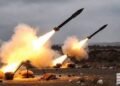








The United States and Iran have exchanged military strikes for the first time in several weeks, raising fresh concerns about the security of the Strait of Hormuz and the wider conflict in the Middle East.
The latest confrontation began after US forces attacked two rocket launchers on Larak Island, located in the Strait of Hormuz near Iran’s major port city of Bandar Abbas.
Iran’s Islamic Revolutionary Guard Corps (IRGC) said the American attack killed two people and wounded two others. The Iranian military organisation also warned that the United States would face a response.
US Central Command (Centcom), however, said its forces carried out what it described as a limited and precise operation after detecting preparations by Iran to launch rockets and deploy sea mines in the strategic waterway.
Iran Reports Retaliatory Attacks
Iran subsequently said it had launched strikes against US military facilities in Jordan.
Jordanian authorities confirmed that eight missiles were intercepted early Monday morning, although the circumstances surrounding their launch were attributed by Iran to its retaliatory action.
Iranian state television also reported that Iranian forces had used drones against an air base in the United Arab Emirates.
The UAE Ministry of Defence rejected the report that Al-Minhad Air Base had been attacked, describing the claim as unfounded. However, the ministry confirmed that one drone had been intercepted.
The conflicting accounts could not immediately be independently verified.
First Known US Attack Since July
The attack on Larak Island is particularly significant because it is reportedly the first known US strike against Iran since President Donald Trump paused a renewed American military campaign in late July.
The return to direct military action could further complicate efforts to prevent the conflict from expanding across the region.
Larak Island occupies a strategically important position near the Strait of Hormuz, one of the world’s most important maritime routes.
The island lies close to Bandar Abbas and sits along a waterway through which a significant share of global energy supplies has historically passed.
Strait of Hormuz Remains a Major Concern
The security of the Strait of Hormuz has become increasingly important since the conflict began.
Before the war, roughly one-fifth of the world’s oil and liquefied natural gas shipments travelled through the waterway.
Since the conflict began in February, shipping through the strait has been severely disrupted, contributing to sharp movements in international oil prices.
Iran has also reportedly demanded that tanker operators route vessels near Larak Island for inspection and has allegedly required some ships to pay substantial fees before crossing.
What Happens Next?
The latest exchange of attacks introduces another major uncertainty into an already volatile regional situation.
The US says its strike was intended to prevent an imminent threat involving rockets and sea mines, while Iran has presented the attack as an act requiring retaliation.
With both sides issuing warnings and military activity once again taking place around the Strait of Hormuz, concern is growing over the possibility of further escalation.
For international energy markets and the global shipping industry, developments around the waterway will be closely watched in the days ahead.