






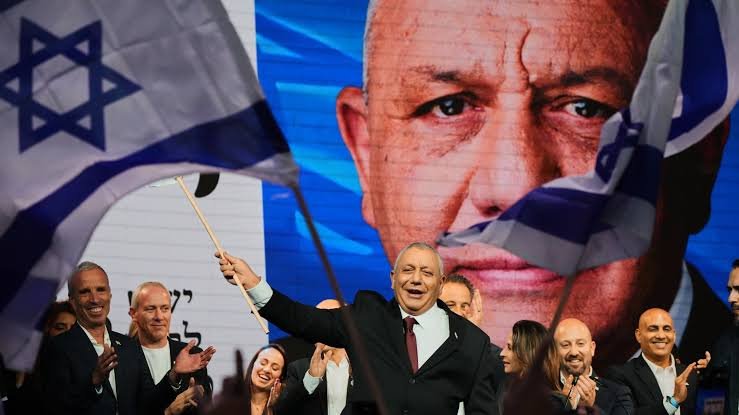
Israeli Prime Minister Benjamin Netanyahu and opposition leader Gadi Eisenkot are facing a difficult path to forming the next government, with partial election results showing neither political bloc has secured a parliamentary majority.
With more than 60 per cent of ballots counted, Netanyahu’s Likud-led bloc was projected to hold 56 seats in the 120-member Knesset, while the bloc led by Eisenkot’s Yashar party had 48 seats. Arab-led parties were projected to hold 16 seats, according to figures reported by The Times of Israel on Wednesday.
A minimum of 61 seats is required to secure a majority in the Knesset, Israel’s parliament. The results remain provisional as counting continues.
Netanyahu’s Likud Leads as the Largest Party
Although neither bloc has secured enough seats to govern independently, Netanyahu’s Likud party is emerging as the largest single party in the election.
The outcome leaves the prime minister seeking support from other political parties to assemble a governing coalition.
Speaking to supporters, Netanyahu called for a strong right-wing government and indicated that he intended to continue leading the country.
However, the partial results suggest that his political allies may need additional support to reach the parliamentary threshold required to form a government.
Eisenkot Says Israelis Voted for Change
Eisenkot, a former military chief who leads the newly formed Yashar party, has presented the election as an opportunity to end Netanyahu’s time in office.
He argued that the results reflected public demand for political change and insisted that the opposition would work to establish a new government.
Despite the challenge to Netanyahu’s leadership, Eisenkot’s bloc also remains short of the 61 seats needed for a majority based on the reported partial count.
The opposition’s next steps are likely to depend on negotiations with other parties, including groups that have traditionally remained outside governing coalitions.
Arab-Led Parties Could Hold the Balance
Arab-led parties are emerging as potentially influential players in the coalition negotiations, with the partial count putting them at approximately 16 seats.
Their combined strength could prove decisive if neither Netanyahu’s allies nor Eisenkot’s opposition bloc can secure sufficient support independently.
However, whether the Arab-led parties would support or join a coalition led by Eisenkot remains uncertain. Netanyahu has publicly opposed forming a government that depends on Arab parties.
The political calculations could therefore become complicated as party leaders explore possible alliances and conditions for cooperation.
Coalition Negotiations Expected
Israel’s electoral system generally requires parties to form coalitions because no single party has historically won an outright majority of Knesset seats.
With neither main bloc currently reaching the required threshold, coalition negotiations are expected to play a central role in determining the next government.
The final outcome may change as additional ballots are counted, including votes submitted through special procedures.
For now, Likud’s position as the largest party does not guarantee Netanyahu another term, just as Eisenkot’s challenge does not ensure that the opposition can form a government.
The election remains inconclusive, leaving Israel facing a period of political negotiations before the next administration can be determined.