



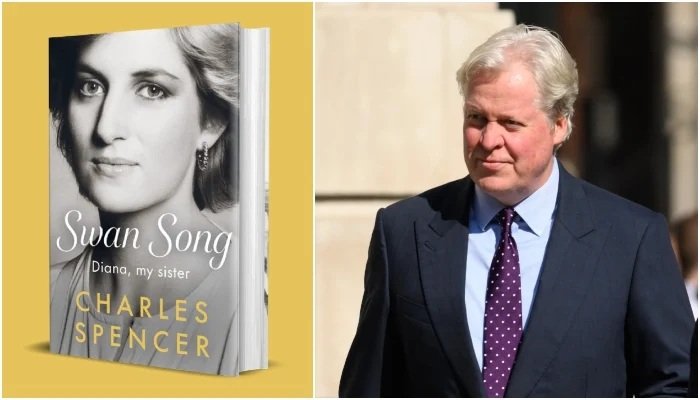
A new memoir by Charles Spencer, the younger brother of Princess Diana, has brought fresh attention to the late Princess of Wales, her relationship with the royal family and the events surrounding her death in Paris.
Titled Swan Song: Diana, My Sister, the 384-page memoir explores Spencer’s memories of growing up with Diana, her years as a member of the royal family and the aftermath of her death in 1997.
The book, published by Penguin and translated into 12 languages, has attracted international attention because of Spencer’s personal recollections and claims involving King Charles III.

Spencer Says He Wanted to Correct the Record
Spencer, the 9th Earl Spencer, said he decided to write the memoir because he believes some accounts of his sister’s life have gradually turned into accepted narratives that do not reflect his own memories.
With the 30th anniversary of Diana’s death approaching, Spencer said he wanted to preserve his recollections and present what he considers a more personal picture of the woman he knew as his sister.
One of the most controversial sections concerns a conversation he says he had with the then Prince Charles shortly before Diana’s funeral.
Dispute Over William and Harry’s Role at the Funeral
According to Spencer’s account, he and Charles disagreed over whether Diana’s two sons, Prince William and Prince Harry, should walk behind their mother’s coffin during the funeral procession.
Spencer says he objected because he believed the boys should be protected from the enormous emotional pressure surrounding the funeral.
He recalls that the conversation became heated and alleges that Charles told him:
“Rest assured, we’ll forget her soon enough.”
Spencer has continued to stand by the recollection and says those were the words he remembers hearing.
The claim has attracted considerable attention because of its implications for the relationship between Diana’s family and the royal household following her death.
Buckingham Palace Responds
Buckingham Palace rarely comments on claims contained in books about members of the Royal Family.
However, in an unusual response to Spencer’s account, a palace spokesperson suggested that grief can affect how people remember painful events.
The spokesperson said that “the pain of fraternal grief can cloud reason, affect judgment and colour memory in ways others do not recognise.”
Spencer rejected that suggestion and maintained that his recollection was accurate.
The disagreement leaves the alleged conversation as a contested personal account rather than an independently established fact.
Spencer’s Recollection of Charles After Diana’s Death
The memoir also contains Spencer’s memories of speaking with Charles after Diana’s death.
Spencer describes the then Prince of Wales as sounding extremely upbeat when he learned that Diana had died, comparing his tone to that of someone who had unexpectedly won a lottery.
Spencer connects his interpretation of the conversation to Charles’s relationship with Camilla Parker Bowles.
That interpretation is Spencer’s own and forms part of his personal recollection of the events.
Diana’s Death Changed the Royal Family
Princess Diana died on August 31, 1997, at the age of 36 after the Mercedes in which she was travelling crashed inside the Pont de l’Alma tunnel in Paris.
The vehicle was being pursued by paparazzi photographers.
Her death produced an extraordinary public reaction in Britain and around the world.
Millions of people mourned Diana, while her funeral became one of the most widely watched royal events of the era.
Charles Spencer delivered the eulogy at Westminster Abbey one week after his sister’s death.
More Than a Royal Controversy
Although the claims involving King Charles have generated much of the publicity surrounding Swan Song, Spencer presents the memoir as something broader than a book of royal revelations.
The memoir looks back at the siblings’ childhood, their parents’ divorce, Diana’s marriage to Charles and her transition from a young woman into one of the world’s most recognisable public figures.
Spencer’s central aim appears to be preserving his personal memory of Diana rather than simply revisiting the controversies that followed her death.
Nearly three decades after Diana’s death, however, the memoir has once again placed her family relationships and the circumstances surrounding her final years at the centre of public discussion.