


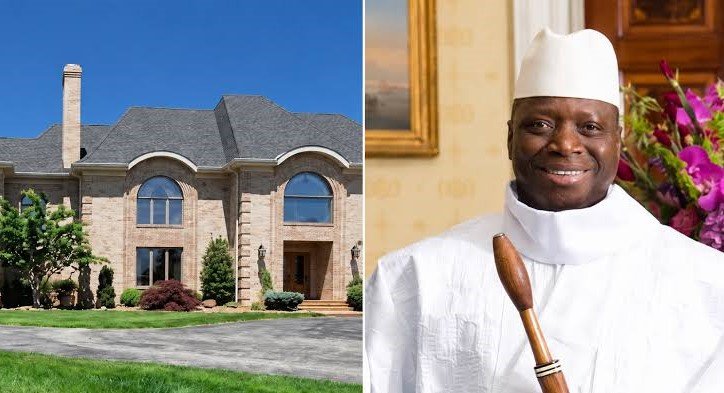
The United States has agreed to return $2.5 million to The Gambia following the sale of a Maryland property linked to former Gambian President Yahya Jammeh.
The funds are expected to support victims of human rights violations committed during Jammeh’s 22-year rule.
The agreement was signed in Banjul on Friday by officials from The Gambia’s Ministry of Finance and representatives of the United States Embassy.

According to the U.S. Embassy, the transfer reflects the two countries’ shared efforts to combat corruption, money laundering and the misuse of public resources.
Property was seized by US authorities
The property, located in Potomac, Maryland, was purchased in 2010 by Zineb Jammeh, the former president’s wife.
U.S. authorities later confiscated the property after determining that it had been acquired with funds allegedly linked to bribery and the misappropriation of public money.
The property was confiscated in 2022, about five years after Yahya Jammeh left office.
The former president initially refused to accept the results of the 2016 election but eventually left The Gambia in January 2017 following regional diplomatic and military pressure.
He has since remained in exile in Equatorial Guinea.
Money to support victims
The $2.5 million will be directed towards a fund intended to support victims of human rights abuses associated with the Jammeh era.
The move forms part of The Gambia’s broader transitional-justice process.
After taking office in 2017, President Adama Barrow established the Truth, Reconciliation and Reparations Commission to investigate human rights violations committed between 1994 and 2017.
The commission heard testimony concerning alleged killings, torture, enforced disappearances and other abuses during Jammeh’s rule.
Wider accountability efforts
The Gambian government has also pursued the recovery of assets associated with the former president.
A commission of inquiry established by the Barrow administration examined Jammeh’s financial dealings. U.S. government reporting said the commission found that significant public resources had been wasted, misappropriated or diverted and recommended action over alleged economic crimes.
The United States has also supported The Gambia’s broader transitional-justice efforts, including mechanisms intended to pursue accountability for serious human rights violations committed during the Jammeh era.
The latest agreement therefore links the recovery of proceeds from a former regime-linked asset with efforts to provide support to victims.