







The Gambia’s worsening electricity crisis is becoming more than an energy problem, as prolonged blackouts fuel public anger and add to political pressure ahead of the country’s December 2026 presidential election.
In some communities, electricity outages have reportedly lasted between 16 and 48 hours, leaving households and businesses struggling through periods of intense seasonal heat.
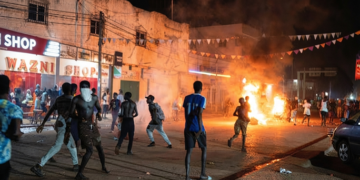
The frustration eventually spilled onto the streets, with demonstrations reported in Banjul, Kanifing and Serrekunda, as well as parts of the West Coast Region. Protesters used candles, barricades and public gatherings to express their anger over the deteriorating power situation.
What initially appeared to be a protest over electricity supply has increasingly taken on a broader political dimension, with demonstrators gathering around government and electricity-related facilities.
Electricity Crisis Raises Questions About Governance
For many Gambians, prolonged power cuts represent more than the inconvenience of living without electricity.
Repeated outages have triggered questions about the management of the country’s power infrastructure, the effectiveness of public investment and the government’s ability to deliver reliable basic services.
Lawmakers have also called for deeper reforms, arguing that the country needs long-term solutions to recurring problems in electricity generation, transmission and distribution rather than temporary measures whenever the system comes under pressure.
Fast Facts
- Reported outage duration: Up to 48 hours in some communities
- Major pressures: High electricity demand, equipment failures and reduced hydropower availability
- System vulnerability: Dependence on domestic generation and regional electricity imports
- Immediate response: Additional generators and a new 24MW generation unit
- Long-term proposal: A 50MW solar power plant
- Political backdrop: December 2026 presidential election
Why the Power System Remains Vulnerable
The electricity challenge is linked to deeper structural weaknesses within the country’s energy system.
Ageing generation equipment, maintenance difficulties and limitations in transmission infrastructure have affected the ability of domestic facilities to consistently meet demand.
The Gambia has also benefited from regional electricity cooperation through arrangements such as the West African Power Pool and the OMVG transmission network. These connections provide access to electricity, including hydropower, but they can also expose the country to external supply disruptions when imported power is interrupted and domestic reserves are insufficient.
As demand rises, particularly during periods of extreme heat, weaknesses across the entire electricity chain become more visible.
Government Under Pressure to Deliver Results
The authorities have acknowledged the seriousness of the situation and announced measures aimed at increasing electricity generation.
Plans include additional generation equipment, a new 24MW unit and proposals for expanding solar power capacity. The government has also indicated that monitoring and emergency response mechanisms are being strengthened.
However, increasing generation alone may not solve the problem.
Energy experts have consistently pointed to the need for investment across the entire system, including transmission networks, distribution infrastructure, equipment maintenance and the financial sustainability of the national utility.
For consumers, the ultimate test will be whether additional power actually reaches homes, businesses and public institutions reliably.
A Political Test Before December
The electricity crisis comes at a sensitive political moment for The Gambia.
With the December 2026 presidential election approaching, prolonged blackouts could become an important campaign issue as citizens assess the government’s performance on basic infrastructure and living conditions.
The protests demonstrate how quickly an economic or infrastructure problem can evolve into a wider political grievance.
For the government, restoring reliable electricity may therefore be about more than keeping the lights on. It could also be crucial to rebuilding public confidence ahead of the election.