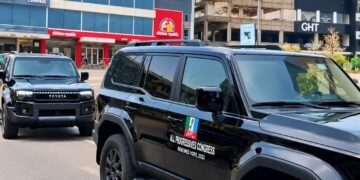







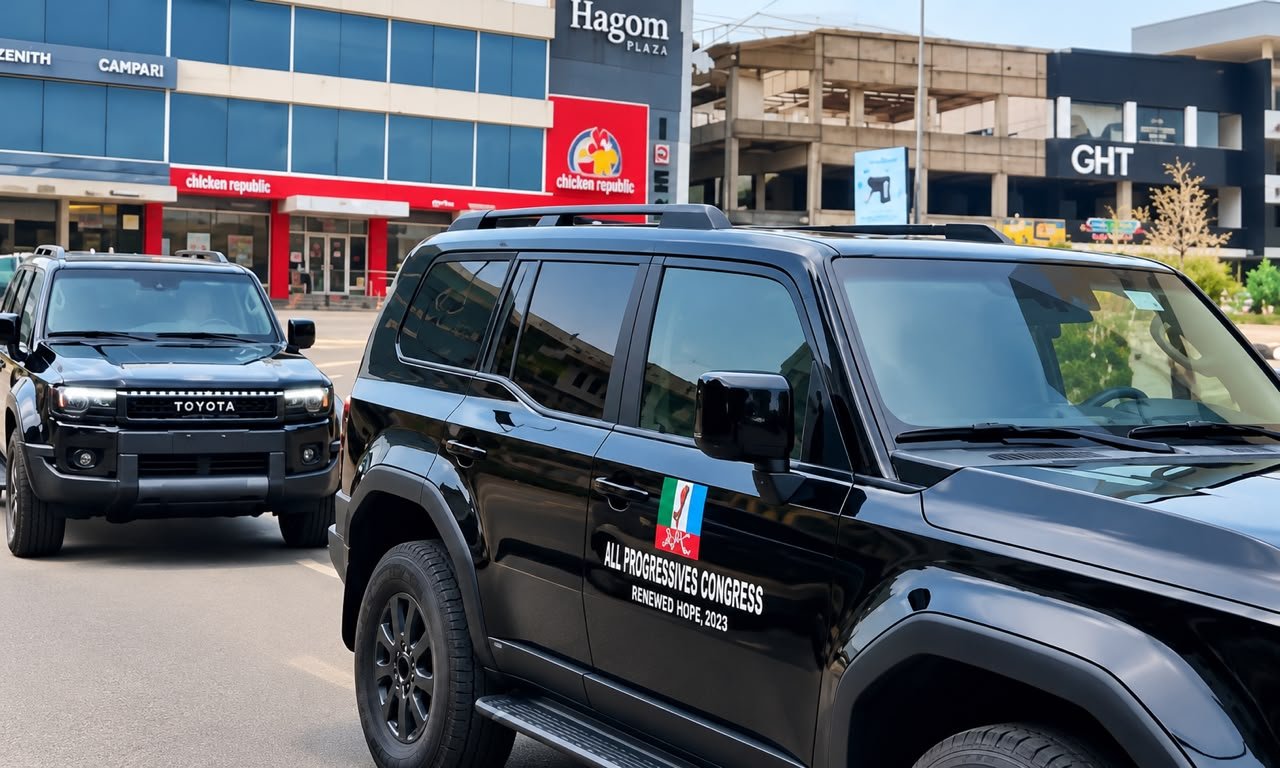
The presentation of seven brand-new 2026 Toyota Land Cruiser Prado SUVs to selected APC youth leaders has triggered public criticism, raising questions about political spending, transparency and the economic pressures facing Nigerian households.
A video showing seven new Toyota Land Cruiser Prado SUVs presented to selected youth leaders of the All Progressives Congress (APC) has sparked controversy as Nigeria prepares for the 2027 general elections.
The video was shared by Dayo Israel, the APC’s National Youth Leader, who said the vehicles would support election mobilisation and grassroots political activities.
Israel also acknowledged the support of First Lady Oluremi Tinubu for the party’s youth structure. The video was subsequently deleted following public criticism.
The controversy has focused attention on the cost of political mobilisation, the source of funding for expensive gifts and the challenges confronting ordinary Nigerians struggling with living expenses.
Who Paid for the Seven SUVs?
In an interview with the International Centre for Investigative Reporting (ICIR) published on October 26, Israel said the vehicles were gifts from donors and denied that they were funded through government allocations or taxpayers’ money.
He explained that the video was removed because of public sensitivity surrounding the issue, rather than an intention to conceal wrongdoing.
However, he did not publicly identify the donors or provide documents detailing the funding arrangements and purchase prices.
Consequently, the precise cost of the vehicles and the circumstances of the donations remain matters requiring further clarification.
The distinction is important: public criticism of an expensive political gift does not establish that public funds were used. Equally, a claim that vehicles were privately donated does not prevent legitimate questions about the source and terms of the donations.
What Could the Vehicles Cost?
BusinessDay reported that a new 2026 Toyota Land Cruiser Prado could cost between ₦120 million and ₦160 million, depending on the specifications and dealer.
Using that estimate, seven vehicles could be valued at between ₦840 million and ₦1.12 billion.
These figures are market estimates, not a verified invoice or confirmed purchase price for the vehicles shown in the video. Actual costs may vary depending on specifications, importation expenses, taxes and other charges.
Nevertheless, the estimates help explain why the video attracted considerable public attention.
For many Nigerians facing difficult financial decisions, the prospect of hundreds of millions of naira being spent on vehicles for political mobilisation raises questions about priorities and the distribution of resources.
Economic Pressure Fuels Public Reaction
The controversy comes at a time when many households continue to struggle with the cost of food, transportation, rent, education and healthcare.
According to the National Bureau of Statistics, Nigeria’s headline inflation rate declined from 15.39 per cent in August 2026 to 14.63 per cent in September.
However, annual food inflation increased slightly from 19.57 per cent to 19.59 per cent over the same period.
Although the decline in headline inflation indicates that the overall rate of price increases has slowed, it does not mean that prices have returned to previous levels or that households have recovered their purchasing power.
For families whose incomes remain under pressure, the sight of expensive vehicles being distributed for political activities can intensify perceptions of inequality.
The criticism therefore extends beyond the vehicles themselves to questions about whether political leaders understand the everyday challenges facing the people whose votes they seek.
APC’s Case: Mobilisation Requires Resources
There is also an argument in favour of providing vehicles for political work.
Large political parties require logistics to organise meetings, coordinate volunteers, reach communities and prepare for election campaigns. Vehicles can help party officials travel between local government areas and support grassroots engagement.
From the APC’s perspective, the vehicles may be intended to strengthen its mobilisation network ahead of a competitive election season.
Political parties are entitled to organise their activities and receive lawful private donations, subject to applicable laws and financial disclosure requirements.
However, the practical value of campaign logistics does not automatically settle questions about the cost, source of funding or public presentation of the vehicles.
Those details matter because political parties operate within a wider social environment in which citizens increasingly demand accountability from public figures.
Atiku and Other Critics Demand Answers
Opposition figures, including former Vice President Atiku Abubakar and members of the African Democratic Congress (ADC), have criticised the development and called for clarification.
Their concerns focus on the apparent contrast between expensive political gifts and the financial pressures facing ordinary Nigerians.
Such criticism does not establish that government money financed the vehicles or that any law was broken. Instead, it underscores the importance of making the funding arrangements clear enough for the public to assess the claims being made.
If the vehicles were privately donated, identifying the donors