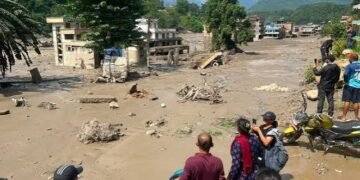







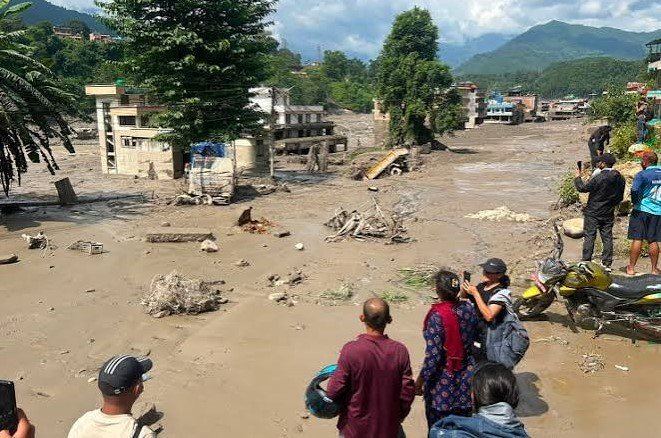
A catastrophic flash flood and mudslide tore through the mountainous border region between Nepal and Tibet this week, leaving more than 150 people dead and setting off a desperate search for hundreds of missing tourists, pilgrims, and local residents.
The disaster struck a stretch of terrain long favored by trekkers and religious travelers, turning a scenic corridor into a scene of devastation within moments. According to Nepal’s tourist board, the missing include more than 100 Indian nationals, 54 Americans, and 33 Britons — a reflection of just how international the area’s foot traffic tends to be. More than 100 Nepali citizens are also unaccounted for.
Across the border in Tibet, the toll has been just as severe. Chinese state media report three confirmed deaths and 265 people missing. Footage broadcast by state broadcaster CCTV captured the terrifying moment a surge of water and mud slammed into buildings near a border crossing, sweeping away everything in its path.
The missing aren’t only tourists. Dozens of Nepalese police officers and army personnel dispatched to the region, along with utility workers maintaining local power infrastructure, are also among those unaccounted for — a sign of how quickly the flooding overwhelmed even those trained to respond to emergencies.
For those who survived, the experience was harrowing. One woman recounted watching her own family swept away in front of her, saved from the same fate only because she and her son managed to scramble onto a rooftop as the water rose.
In the immediate aftermath, authorities suspected an earthquake had triggered the landslide that unleashed the flooding. But new analysis from the US Geological Survey has revised that account: the seismic activity detected in the region wasn’t the cause of the landslide — it was the result of it, generated by the sheer force of the moving earth and debris.
Search and rescue operations are ongoing on both sides of the border, though the scale of destruction and the remoteness of the terrain are complicating efforts to reach survivors and recover the dead.