






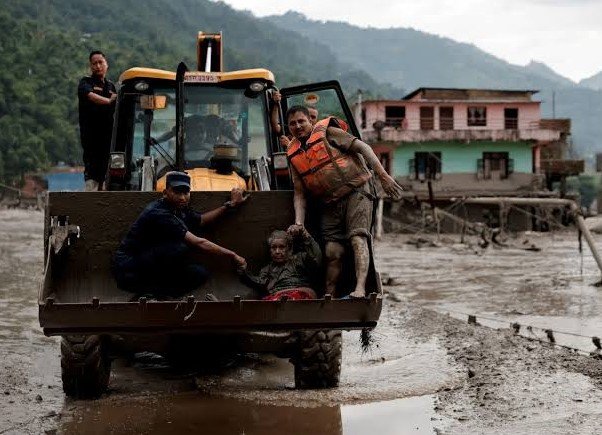
More than 160 people have been killed after a devastating flash flood and mudslide struck the Nepal-Tibet region, while rescue teams continue to face major difficulties reaching affected areas.
Hundreds of tourists and visitors are also reported missing, including more than 100 people from India, 54 from the United States, 34 from Australia and 33 from the United Kingdom. More than 100 Nepali nationals are also reportedly missing.
The affected area is popular with pilgrims and trekkers, raising fears that the final casualty figure could increase as rescuers gain access to isolated communities.
Rescue Efforts Hampered
Nepalese police officers, army personnel and power workers are among those reported missing following the disaster.
Rescue teams are working to reach survivors and assess the full extent of the destruction, but damaged infrastructure, debris and difficult terrain are complicating the operation.
One survivor described the horror of watching family members being swept away by the flood. She and her son survived after managing to climb onto a rooftop.
Risk of Further Flooding
Experts have warned that the disaster may not be over.
Large quantities of debris have accumulated in a nearby river, creating concerns that another blockage or sudden release of water could trigger a second flooding event.
Authorities and emergency teams are therefore facing the difficult task of rescuing people while also monitoring the surrounding area for additional hazards.
Earthquake Report Corrected
Initial reports suggested that an earthquake may have triggered the disaster.
However, the US Geological Survey (USGS) later clarified that the seismic signal initially identified as a magnitude 4.4 earthquake was actually generated by a glacial collapse and debris flow.
According to the USGS, further analysis of seismic data and satellite imagery showed that no earthquake had occurred. Instead, a large glacial collapse and debris flow caused catastrophic impacts downstream.
Nepali authorities had earlier suggested that a massive section of ice could have collapsed from a mountain, carrying rocks and other material into the waterways.
Scientists are continuing to investigate the precise sequence of events that caused the catastrophic flooding and mudslides.
International Assistance
The scale of the disaster has prompted international concern, with the United States, China, European Union and India among those offering assistance or sending relief supplies.
As rescue operations continue, families are waiting for information about missing relatives while authorities work to establish the full death toll and locate survivors.
The disaster has highlighted the severe risks facing communities and travellers in mountainous areas, where glacial collapses, landslides and sudden flooding can develop rapidly and leave little time for evacuation.