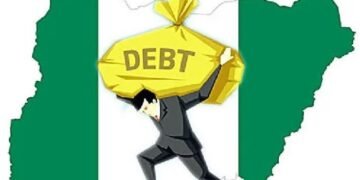








Twelve Nigerian states, whose governors are nearing the conclusion of their current terms, are collectively burdened with an estimated debt of approximately N5.3 trillion, prompting renewed inquiries regarding the financial responsibilities that will be assumed by the incoming administrations.
The states affected include Adamawa, Yobe, Nasarawa, Kwara, Ogun, Gombe, Bauchi, Lagos, Borno, Oyo, Imo, and Bayelsa.
The governors presiding over these states are Umaru Fintiri, Mai Mala Buni, Abdullahi Sule, AbdulRahman AbdulRazaq, Dapo Abiodun, Inuwa Yahaya, Bala Mohammed, Babajide Sanwo-Olu, Babagana Zulum, Seyi Makinde, Hope Uzodimma, and Douye Diri.
Data from the Debt Management Office indicates that by the first quarter of 2026, these 12 states had accrued domestic liabilities amounting to approximately N2.16 trillion.
Their total external debt is estimated at around $2.33 billion, according to the most recent state-level data available.
Most governors are anticipated to complete their second terms by 2027. Notably, Imo State Governor Hope Uzodimma is expected to vacate his position on January 15, 2028, while Bayelsa State Governor Douye Diri’s term is set to conclude on February 14, 2028.
Lagos accounts for over half of the domestic debt.
Among the 12 states, Lagos State is particularly notable due to the magnitude of its domestic debt.
As reported by the DMO, Lagos had a domestic debt of approximately N1.205 trillion as of the first quarter of 2026, which constitutes more than half of the total domestic debt of N2.16 trillion recorded across the 12 states.
In contrast, Nasarawa holds the smallest domestic debt within this group, estimated at around N27.15 billion.
Lagos also has the highest external debt, with outstanding foreign liabilities of about $1.174 billion according to the DMO’s 2025 external debt profile.
Yobe, on the other hand, has the lowest external debt among the 12 states, estimated at approximately $46.67 million.
These figures illustrate a significant disparity in the financial conditions of the states, with some administrations incurring additional debts while others have managed to decrease either their domestic or external liabilities.
Debt levels differ from one state to another.
A review of the debt records passed down to governors reveals a varied landscape.
Some state administrations have increased their borrowing during their tenure, while others have seen decreases in specific debt categories.
The overall amount may also fluctuate before the governors conclude their terms if further borrowing occurs or if the Debt Management Office revises its records.
Consequently, the ultimate financial status of each state will hinge not only on current obligations but also on new loans, repayments, and other modifications to their debt portfolios prior to the next administrations assuming office.
As the 2027 transition nears, these figures are expected to remain a significant topic in political discussions, especially since incoming governments will need to reconcile inherited debt with expenditures on infrastructure, salaries, social services, and other essential priorities.