



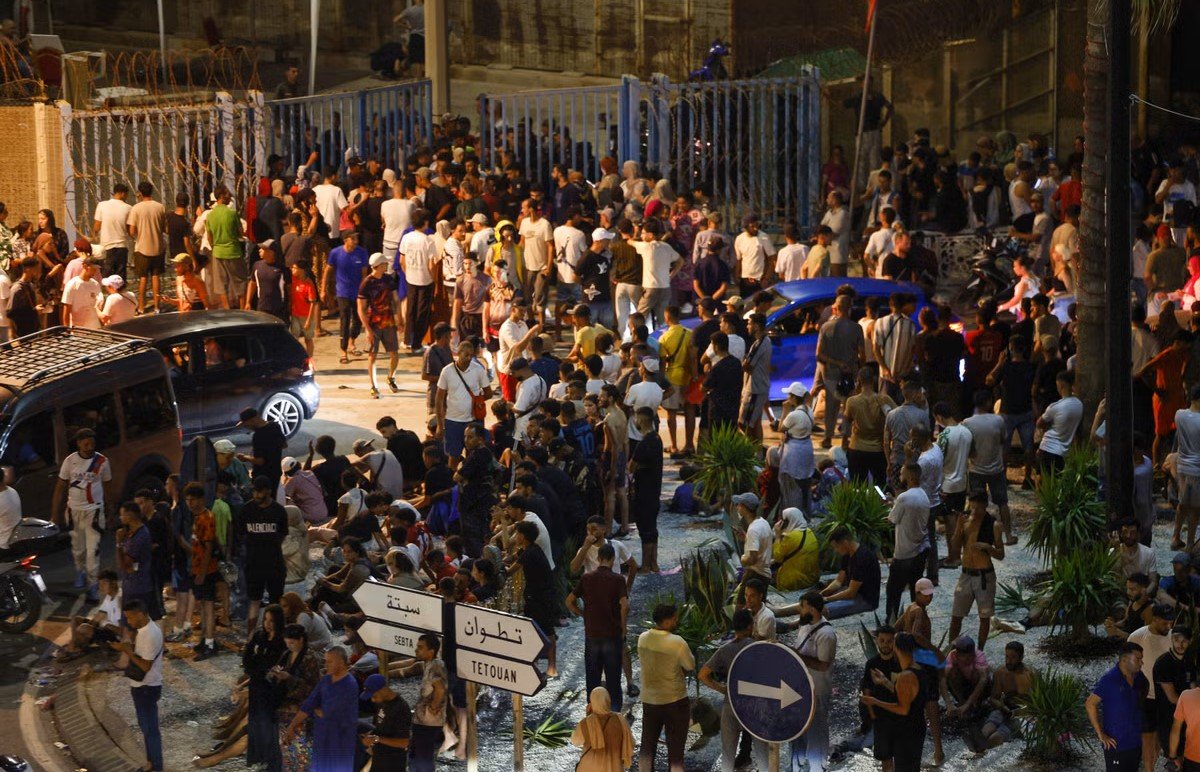
Spanish authorities report that approximately 49,000 migrants have entered the North African enclave of Ceuta from Morocco in the last 24 hours. This influx has led Madrid to deploy troops, as the territory faces one of its largest migration waves in recent history.
Officials noted that thousands of migrants accessed the Spanish area by land and sea. Online videos show large groups swimming past border barriers to reach Ceuta, and local media indicated that crossings persisted throughout the night.
Authorities confirmed at least 18 people have died in recent days while attempting the hazardous journey into the enclave.

This surge follows a ruling by Spain’s Supreme Court that migrants intercepted at sea en route to Ceuta or Melilla cannot be immediately returned to Morocco. This decision has sparked further debate over migration management along Europe’s southern borders.
Ceuta, situated on Morocco’s northern coast, has historically been a vital gateway for migrants aiming for Europe. Along with nearby Melilla, it represents the European Union’s only land border with Africa.
Spanish officials highlighted that the influx over the past day is equivalent to more than half of Ceuta’s estimated population of 83,600, significantly straining local authorities and emergency services.
Responding to appeals from local officials, the Spanish government has dispatched armed forces to bolster security in both Ceuta and Melilla. Authorities also reported that between 300 and 400 migrants crossed into Melilla overnight.
The recent flow of migrants has reignited tensions between Spain and Morocco, which have longstanding disagreements over the status of the two North African enclaves. While Morocco asserts sovereignty over Ceuta and Melilla, Spain affirms that both are integral parts of the country with constitutional status matching its mainland autonomous regions.
Spanish authorities continue with rescue efforts and security patrols as they work to manage this unprecedented wave of migrant arrivals.