






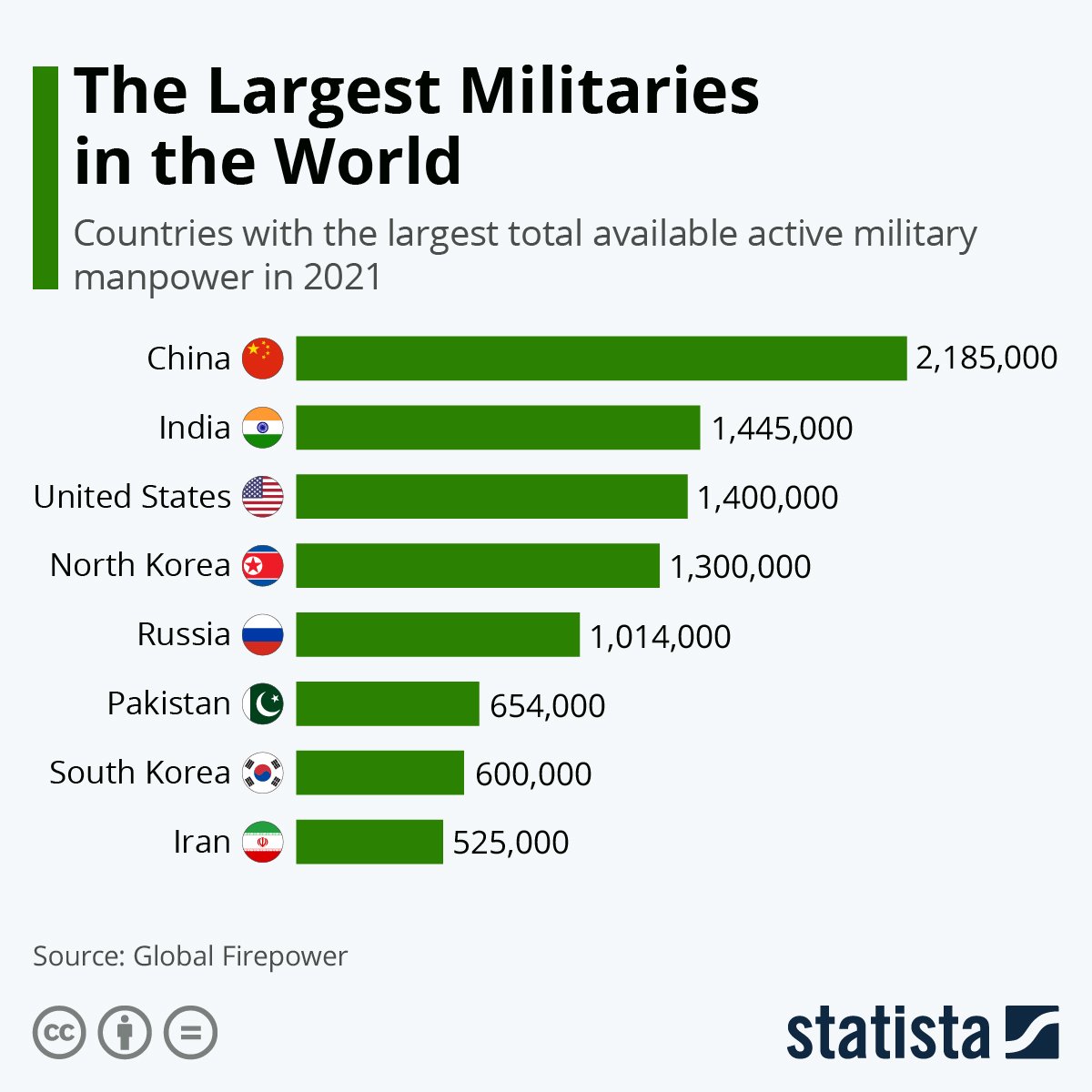
The size of a country’s military is an important measure of its national defence capacity, manpower and ability to protect its territorial integrity.
Over the past century, the world’s military balance has changed significantly. From the powerful European armies of the early 1900s to the massive military forces of the United States, China, Russia and India, military strength has continued to evolve alongside technological advancement, economic development and international security challenges.
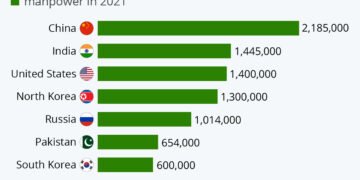
According to historical military personnel data compiled by the Correlates of War project and presented by Our World in Data, China had the world’s largest military personnel force in 2022, with approximately 2.04 million personnel, followed by India with 1.46 million and the United States with 1.36 million.
North Korea and Russia also ranked among the five largest military forces.
The historical period from 1900 to 2022 covers major global conflicts, including the First World War, Second World War, Cold War and modern international security developments.
Top 20 countries with the largest military personnel in 2022
| Rank | Country | Military personnel |
|---|---|---|
| 1 | China 🇨🇳 | 2,035,000 |
| 2 | India 🇮🇳 | 1,460,000 |
| 3 | United States 🇺🇸 | 1,360,000 |
| 4 | North Korea 🇰🇵 | 1,280,000 |
| 5 | Russia 🇷🇺 | 1,190,000 |
| 6 | Ukraine 🇺🇦 | 688,000 |
| 7 | Pakistan 🇵🇰 | 652,000 |
| 8 | Iran 🇮🇷 | 610,000 |
| 9 | South Korea 🇰🇷 | 555,000 |
| 10 | Ethiopia 🇪🇹 | 503,000 |
| 11 | Vietnam 🇻🇳 | 482,000 |
| 12 | Egypt 🇪🇬 | 439,000 |
| 13 | Indonesia 🇮🇩 | 396,000 |
| 14 | Brazil 🇧🇷 | 367,000 |
| 15 | Thailand 🇹🇭 | 361,000 |
| 16 | Myanmar 🇲🇲 | 356,000 |
| 17 | Türkiye 🇹🇷 | 355,000 |
| 18 | Eritrea 🇪🇷 | 302,000 |
| 19 | Saudi Arabia 🇸🇦 | 257,000 |
| 20 | Colombia 🇨🇴 | 256,000 |
These figures measure military personnel, not overall military power. Weapons, technology, training, logistics, air power and naval capability are separate measures.
Global military rankings: Countries ranked 21–80
| Rank | Country | Personnel |
|---|---|---|
| 21 | Sri Lanka 🇱🇰 | 255,000 |
| 22 | Japan 🇯🇵 | 247,000 |
| 23 | Mexico 🇲🇽 | 216,000 |
| 24 | France 🇫🇷 | 203,000 |
| 25 | Morocco 🇲🇦 | 196,000 |
| 26 | Iraq 🇮🇶 | 193,000 |
| 27 | Germany 🇩🇪 | 183,000 |
| 28 | Israel 🇮🇱 | 170,000 |
| 29 | Syria 🇸🇾 | 169,000 |
| 30 | Taiwan 🇹🇼 | 169,000 |
| 31 | Bangladesh 🇧🇩 | 163,000 |
| 32 | Italy 🇮🇹 | 161,000 |
| 33 | United Kingdom 🇬🇧 | 150,000 |
| 34 | Philippines 🇵🇭 | 145,000 |
| 35 | Nigeria 🇳🇬 | 143,000 |
| 36 | Algeria 🇩🇿 | 139,000 |
| 37 | Democratic Republic of the Congo 🇨🇩 | 134,000 |
| 38 | Greece 🇬🇷 | 132,000 |
| 39 | Cambodia 🇰🇭 | 124,000 |
| 40 | Spain 🇪🇸 | 124,000 |
| 41 | Venezuela 🇻🇪 | 123,000 |
| 42 | Poland 🇵🇱 | 114,000 |
| 43 | Malaysia 🇲🇾 | 113,000 |
| 44 | Angola 🇦🇴 | 107,000 |
| 45 | Sudan 🇸🇩 | 104,000 |
| 46 | Jordan 🇯🇴 | 101,000 |
| 47 | Afghanistan 🇦🇫 | 100,000 |
| 48 | Nepal 🇳🇵 | 97,000 |
| 49 | United Arab Emirates 🇦🇪 | 83,000 |
| 50 | Peru 🇵🇪 | 81,000 |
| 51 | South Africa 🇿🇦 | 74,000 |
| 52 | Argentina 🇦🇷 | 72,000 |
| 53 | Romania 🇷🇴 | 72,000 |
| 54 | Chile 🇨🇱 | 69,000 |
| 55 | Canada 🇨🇦 | 67,000 |
| 56 | Azerbaijan 🇦🇿 | 64,000 |
| 57 | Australia 🇦🇺 | 60,000 |
| 58 | Lebanon 🇱🇧 | 60,000 |
| 59 | Dominican Republic 🇩🇴 | 56,000 |
| 60 | South Sudan 🇸🇸 | 53,000 |
| 61 | Singapore 🇸🇬 | 51,000 |
| 62 | Cuba 🇨🇺 | 49,000 |
| 63 | Belarus 🇧🇾 | 48,000 |
| 64 | Uzbekistan 🇺🇿 | 48,000 |
| 65 | Uganda 🇺🇬 | 45,000 |
| 66 | Armenia 🇦🇲 | 43,000 |
| 67 | Oman 🇴🇲 | 43,000 |
| 68 | Ecuador 🇪🇨 | 41,000 |
| 69 | Yemen 🇾🇪 | 40,000 |
| 70 | Kazakhstan 🇰🇿 | 39,000 |
| 71 | Bulgaria 🇧🇬 | 37,000 |
| 72 | Turkmenistan 🇹🇲 | 37,000 |
| 73 | Tunisia 🇹🇳 | 36,000 |
| 74 | Bolivia 🇧🇴 | 34,000 |
| 75 | Netherlands 🇳🇱 | 34,000 |
| 76 | Chad 🇹🇩 | 33,000 |
| 77 | Niger 🇳🇪 | 33,000 |
| 78 | Rwanda 🇷🇼 | 33,000 |
| 79 | Hungary 🇭🇺 | 32,000 |
| 80 | Burundi 🇧🇮 | 30,000 |
Global military rankings: Countries ranked 81–120
| Rank | Country | Personnel |
|---|---|---|
| 81 | Laos 🇱🇦 | 29,000 |
| 82 | Zimbabwe 🇿🇼 | 29,000 |
| 83 | Serbia 🇷🇸 | 28,000 |
| 84 | Côte d’Ivoire 🇨🇮 | 27,000 |
| 85 | Czech Republic 🇨🇿 | 27,000 |
| 86 | Portugal 🇵🇹 | 27,000 |
| 87 | Tanzania 🇹🇿 | 27,000 |
| 88 | Cameroon 🇨🇲 | 25,000 |
| 89 | El Salvador 🇸🇻 | 25,000 |
| 90 | Norway 🇳🇴 | 25,000 |
| 91 | Kenya 🇰🇪 | 24,000 |
| 92 | Austria 🇦🇹 | 23,000 |
| 93 | Belgium 🇧🇪 | 23,000 |
| 94 | Lithuania 🇱🇹 | 23,000 |
| 95 | Georgia 🇬🇪 | 21,000 |
| 96 | Mali 🇲🇱 | 21,000 |
| 97 | Uruguay 🇺🇾 | 21,000 |
| 98 | Switzerland 🇨🇭 | 20,000 |
| 99 | Finland 🇫🇮 | 19,000 |
| 100 | Guatemala 🇬🇹 | 18,000 |
| 101 | Kuwait 🇰🇼 | 18,000 |
| 102 | Slovakia 🇸🇰 | 18,000 |
| 103 | Croatia 🇭🇷 | 17,000 |
| 104 | Qatar 🇶🇦 | 17,000 |
| 105 | Ghana 🇬🇭 | 16,000 |
| 106 | Mauritania 🇲🇷 | 16,000 |
| 107 | Denmark 🇩🇰 | 15,000 |
| 108 | Honduras 🇭🇳 | 15,000 |
| 109 | Sweden 🇸🇪 | 15,000 |
| 110 | Zambia 🇿🇲 | 15,000 |
| 111 | Madagascar 🇲🇬 | 14,000 |
| 112 | Paraguay 🇵🇾 | 14,000 |
| 113 | Senegal 🇸🇳 | 14,000 |
| 114 | Somalia 🇸🇴 | 14,000 |
| 115 | Togo 🇹🇬 | 13,000 |
| 116 | Benin 🇧🇯 | 12,000 |
| 117 | Cyprus 🇨🇾 | 12,000 |
| 118 | Nicaragua 🇳🇮 | 12,000 |
| 119 | Bosnia and Herzegovina 🇧🇦 | 11,000 |
| 120 | Kyrgyzstan 🇰🇬 | 11,000 |
Global military rankings: Countries ranked 121–159
| Rank | Country | Personnel |
|---|---|---|
| 121 | Malawi 🇲🇼 | 11,000 |
| 122 | Mozambique 🇲🇿 | 11,000 |
| 123 | Republic of the Congo 🇨🇬 | 10,000 |
| 124 | Guinea 🇬🇳 | 10,000 |
| 125 | Mongolia 🇲🇳 | 10,000 |
| 126 | Namibia 🇳🇦 | 10,000 |
| 127 | Botswana 🇧🇼 | 9,000 |
| 128 | Central African Republic 🇨🇫 | 9,000 |
| 129 | New Zealand 🇳🇿 | 9,000 |
| 130 | Sierra Leone 🇸🇱 | 9,000 |
| 131 | Tajikistan 🇹🇯 | 9,000 |
| 132 | Albania 🇦🇱 | 8,000 |
| 133 | Bahrain 🇧🇭 | 8,000 |
| 134 | Djibouti 🇩🇯 | 8,000 |
| 135 | Ireland 🇮🇪 | 8,000 |
| 136 | North Macedonia 🇲🇰 | 8,000 |
| 137 | Brunei 🇧🇳 | 7,000 |
| 138 | Burkina Faso 🇧🇫 | 7,000 |
| 139 | Estonia 🇪🇪 | 7,000 |
| 140 | Latvia 🇱🇻 | 7,000 |
| 141 | Jamaica 🇯🇲 | 6,000 |
| 142 | Slovenia 🇸🇮 | 6,000 |
| 143 | Gabon 🇬🇦 | 5,000 |
| 144 | Moldova 🇲🇩 | 5,000 |
| 145 | Trinidad and Tobago 🇹🇹 | 5,000 |
| 146 | Fiji 🇫🇯 | 4,000 |
| 147 | Guinea-Bissau 🇬🇼 | 4,000 |
| 148 | Papua New Guinea 🇵🇬 | 4,000 |
| 149 | The Gambia 🇬🇲 | 4,000 |
| 150 | Guyana 🇬🇾 | 3,000 |
| 151 | Belize 🇧🇿 | 2,000 |
| 152 | Lesotho 🇱🇸 | 2,000 |
| 153 | Liberia 🇱🇷 | 2,000 |
| 154 | Malta 🇲🇹 | 2,000 |
| 155 | Montenegro 🇲🇪 | 2,000 |
| 156 | Suriname 🇸🇷 | 2,000 |
| 157 | Bahamas 🇧🇸 | 2,000 |
| 158 | Timor-Leste 🇹🇱 | 2,000 |
| 159 | Barbados 🇧🇧 | 1,000 |
| Display position | Country | Personnel |
|---|---|---|
| 160 | Cabo Verde 🇨🇻 | 1,000 |
| 161 | Equatorial Guinea 🇬🇶 | 1,000 |
| 162 | Haiti 🇭🇹 | 1,000 |
| 163 | Tonga 🇹🇴 | 1,000 |
Countries with zero or unavailable military personnel in the dataset
The following countries and territories were listed with zero personnel in this particular historical dataset:
-
Andorra
-
Antigua and Barbuda
-
Costa Rica
-
Dominica
-
Grenada
-
Iceland
-
Kiribati
-
Liechtenstein
-
Luxembourg
-
Maldives
-
Marshall Islands
-
Mauritius
-
Federated States of Micronesia
-
Monaco
-
Nauru
-
Palau
-
Panama
-
Saint Kitts and Nevis
-
Saint Lucia
-
Saint Vincent and the Grenadines
-
Samoa
-
San Marino
-
Seychelles
-
Solomon Islands
-
Tuvalu
-
Vanuatu
The following had unavailable figures in the displayed dataset: Bhutan, Comoros, Libya, São Tomé and Príncipe and Eswatini.
Important: A zero in this historical dataset does not necessarily mean that a country has no security forces, police, coast guard or defence arrangements. Some countries do not maintain conventional standing armies.
Nigeria’s military position in Africa
Nigeria ranked 35th globally in 2022, with approximately 143,000 military personnel.
This placed Nigeria among Africa’s notable military manpower contributors, alongside Ethiopia, Egypt, Eritrea, South Africa, Morocco and Algeria.
Other African countries in the rankings included:
-
Ethiopia – 503,000
-
Egypt – 439,000
-
Eritrea – 302,000
-
Morocco – 196,000
-
Nigeria – 143,000
-
Algeria – 139,000
-
Democratic Republic of the Congo – 134,000
-
Angola – 107,000
-
Sudan – 104,000
-
South Africa – 74,000
-
Uganda – 45,000
-
Rwanda – 33,000
-
Niger – 33,000
-
Ghana – 16,000
-
Senegal – 14,000
-
Kenya – 24,000
How military power changed between 1900 and 2022
The twentieth century witnessed enormous changes in military manpower.
1900–1914: The pre-First World War era
European powers maintained large military establishments as competition over territory, colonial interests and international influence intensified.
1914–1918: First World War
The First World War mobilised millions of soldiers across Europe, Africa, Asia and other parts of the world.
1939–1945: Second World War
The Second World War became one of the largest military mobilisation periods in human history, involving major powers including Germany, the Soviet Union, the United States, Japan, Britain and China.
1945–1991: The Cold War
The United States and Soviet Union emerged as the two principal military superpowers. Their competition involved nuclear weapons, military alliances, military technology and large armed forces.
1991–2022: The modern military era
Following the collapse of the Soviet Union, the global military balance continued to evolve. China expanded its military capabilities, India strengthened its armed forces, and Russia maintained a major military presence.
The war in Ukraine also significantly affected military mobilisation and personnel figures.
Does having the largest army mean having the strongest military?
Not necessarily.
Military strength is determined by several factors, including:
-
Number of active military personnel.
-
Modern fighter aircraft and air defence systems.
-
Naval power and aircraft carriers.
-
Nuclear weapons capability.
-
Advanced missiles and military technology.
-
Intelligence and surveillance capabilities.
-
Military training and combat experience.
-
Defence budgets and logistics.
A country with fewer soldiers may possess more advanced military technology and greater operational capabilities than a country with a larger army.
Conclusion
The 2022 military personnel rankings demonstrate the changing distribution of military manpower around the world.
China, India, the United States, North Korea and Russia occupied the top five positions, while Nigeria ranked among the 40 largest military forces globally.
For African countries, military strength must go beyond troop numbers. Investment in modern equipment, intelligence, training, technology and regional security cooperation remains essential to protecting national sovereignty and maintaining peace.
OBASANJONEWS24 will continue to report on global defence developments, international security and the changing balance of military power.
Sources and editorial information
Data methodology: The principal ranking uses the Correlates of War National Material Capabilities Version 7.0 dataset. It measures military personnel under national government command and held ready for combat as of 1 January of the reporting year. It is not a ranking of total military capability.