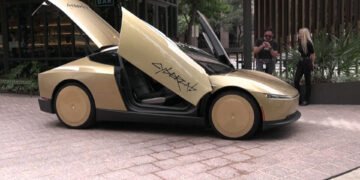








Tesla has taken another major step into the autonomous transportation market with the launch of its driverless “Cybercab” robotaxi on the streets of Austin, Texas.
The electric vehicle manufacturer is positioning the new vehicle as a key part of its ambitions to compete in the rapidly expanding self-driving ride-hailing industry, where companies such as Waymo have already established a significant presence.
Unlike conventional cars, the Cybercab has been designed without a steering wheel or pedals, meaning passengers cannot take control of the vehicle during a journey.
The two-seat electric vehicle uses Tesla’s camera-based autonomous driving technology and artificial intelligence to navigate roads and transport passengers to their destinations without a human driver.
Tesla Takes Aim at Waymo and Uber
The Austin rollout places Tesla in competition with Waymo, one of the leading companies already operating commercial driverless ride-hailing services in the United States.
Waymo currently operates autonomous services across 14 US cities and has more than 4,000 self-driving vehicles, giving the company a considerable advantage in terms of operational experience and network size.
Tesla is hoping its purpose-built Cybercab, combined with its vision-based autonomous driving technology, will allow it to expand quickly and secure a meaningful share of the robotaxi market.
The company’s approach differs from some competitors that use a combination of cameras, radar and lidar sensors. Tesla has instead placed significant emphasis on cameras and artificial intelligence to interpret road conditions and guide its vehicles.
Global Ambitions
Although the Cybercab’s current operation is limited to the United States, Tesla has broader plans for the vehicle.
The company has indicated that it intends to showcase the Cybercab in Chinese cities. However, such demonstrations should not be confused with the start of commercial driverless taxi operations in China.
Any attempt to expand the service internationally will depend heavily on regulatory approval, safety standards and Tesla’s ability to demonstrate that its autonomous system can perform reliably under different traffic and road conditions.
A New Era for Urban Transport?
Tesla’s robotaxi push is part of a wider effort to transform how people move around cities.
If the technology proves reliable and regulators approve wider deployment, Cybercabs could eventually become part of a larger autonomous transportation network operating without conventional drivers.
For now, Austin represents an important testing ground for Tesla’s ambitions.
The success of the Cybercab will ultimately depend not only on the technology itself but also on passenger confidence, safety performance, regulatory acceptance and the company’s ability to scale the service.
Tesla’s latest move signals that the competition for the future of driverless transportation is becoming increasingly intense.