


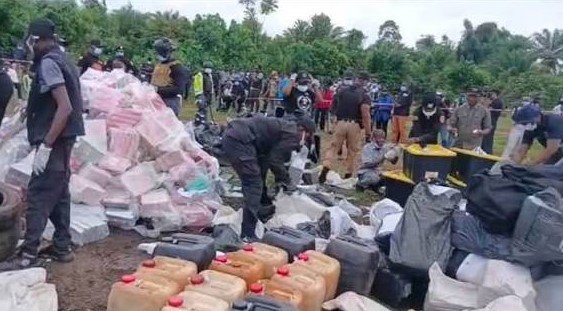
Liberian authorities recently destroyed approximately 4.2 metric tons of cocaine valued at $336 million, marking the aftermath of the country’s most significant drug seizure to date. Investigations have unveiled the involvement of senior police officials in this trafficking operation.
The discovery of a sophisticated transnational drug trafficking network implicated high-ranking law enforcement officers, prompting the large-scale destruction of the seized drugs.
Police Inspector General Gregory O.W. Coleman revealed that the investigation identified several officers suspected of aiding the cocaine’s movement into Liberia. As part of the inquiries, the Chief of the Highway Patrol and the Head of the Major Crimes Unit have been formally charged, while a Deputy Police Commander at Roberts International Airport faces scrutiny for alleged involvement.

Last week, authorities reported seizing nearly four metric tons of cocaine, amounting to about 8,818 pounds, with an estimated street value of $317 million—an historic drug bust for Liberia.
The Ministry of Justice stated that the cocaine was confiscated during a raid on a property in Duazon, roughly 28 kilometers from Monrovia, Liberia’s capital. During this operation, two foreign nationals—a Serbian citizen and a dual Colombian-Spanish national—were arrested and remain under investigation for their potential roles in the trafficking network.
Additionally, authorities destroyed another 237 kilograms of cocaine, valued at over $19 million, which had been seized earlier in June at Roberts International Airport.
Coleman emphasized that destroying these drugs underscores Liberia’s commitment to dismantling organized drug trafficking networks. “This sends a clear message that Liberia is not a sanctuary for drug traffickers,” he stated.
West Africa has increasingly become a key transit hub for cocaine shipments from South America to Europe, as criminal organizations exploit weak border controls and limited law enforcement capacity across the region. Security experts warn that this rising narcotics flow through West Africa is also leading to increased local drug consumption, especially crack cocaine, creating significant public health and security issues.