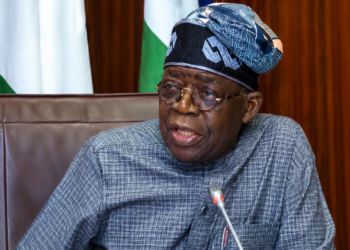



President Bola Tinubu has sanctioned the immediate disbandment of the Presidential Implementation Committee on the Alienation of Federal Government Properties. This decision puts an end to the 25-year-old institution that was initially formed during former President Olusegun Obasanjo’s administration.
Responsibilities previously managed by the committee will now fall under the jurisdiction of Lateef Fagbemi, the Attorney-General of the Federation and Minister of Justice, starting from November 5, 2025.
Announcing this directive, Bayo Onanuga, the President’s Special Adviser on Information and Strategy, noted that B. S. Dutsin-Ma, who served as the committee’s Secretary, has been directed to cease all activities on behalf of both the committee and the Federal Government regarding federal property disposal.

The Presidency indicated that a thorough review of the committee’s operations revealed activities that exceeded its original scope, resulting in various legal challenges nationwide.
The existence of the committee had become increasingly problematic due to these legal entanglements, diminishing the justification for its continuation.
The Presidential Implementation Committee was set up in 2000 by President Obasanjo to manage the privatization, sale, and leasing of federal government properties as part of a monetization initiative aimed at reducing governance costs. The policy intended to convert government-owned assets into revenue while phasing out in-kind benefits for public servants such as housing and vehicles.
This committee included members from several federal ministries like Housing, Justice, Transportation, Health, and Agriculture, along with the Nigeria Police Force. Professor P. T. Ahire was its first secretary.
In March 2001, the Federal Executive Council agreed to establish a Panel of Inquiry which worked extensively to produce a White Paper that shaped the committee’s recommendation implementation.
Despite being a significant public sector reform during Obasanjo’s tenure, the monetization policy stirred considerable controversy over the years. Numerous conflicts arose concerning the valuation and sale of government properties, with accusations of undervaluation, irregular transactions, and biased allocation practices leading to prolonged legal battles across the nation.
With the committee’s disbandment, future issues related to the alienation of federal government properties will be managed by the Attorney-General’s Office.