






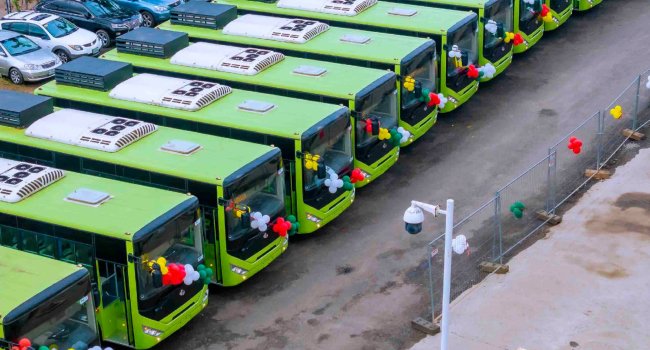
President Bola Ahmed Tinubu has directed the rollout of an additional 500 Compressed Natural Gas (CNG) refuelling stations across Nigeria, as part of the Federal Government’s efforts to reduce transportation costs following the removal of the petrol subsidy.
The new directive is expected to expand the country’s planned CNG refuelling network to 1,000 stations nationwide, with the government hoping that wider access to cheaper fuel will translate into lower transport fares for Nigerians.
Tinubu announced the decision on Thursday after a meeting with state governors, during which discussions focused on measures to reduce the impact of high transportation costs on households and businesses.
According to the President, the governors agreed to take immediate steps within their respective states to bring down transport fares by promoting cheaper energy alternatives, particularly CNG-powered vehicles and electric vehicles.
Federal Government Expands CNG Infrastructure
Tinubu said the additional 500 stations would complement another 500 CNG refuelling stations previously approved earlier in the year.
He explained that the expansion was designed to make CNG more readily available to motorists and transport operators across the country.
The President said the government’s objective was not only to increase the number of CNG stations but also to ensure that Nigerians eventually feel the benefits through reduced transportation costs.
The move comes as the country continues to adjust to the economic consequences of petrol subsidy removal, which has significantly changed fuel prices and increased the operating costs of transport operators.
CNG Could Cut Fuel Costs
Tinubu said vehicles powered by CNG could record substantial savings compared with petrol-powered vehicles.
According to the President, CNG-powered vehicles can spend between 60 and 80 per cent less on fuel than comparable petrol-powered vehicles, depending on operating conditions and fuel prices.
The government believes that reducing the cost of running commercial vehicles could provide transport operators with room to reduce fares while maintaining their businesses.
However, achieving that objective will depend on the availability of CNG, the cost of converting vehicles, the reliability of refuelling infrastructure and the willingness of transport operators to adopt the alternative fuel.
Governors to Work on Lower Transport Fares
The President said state governments would play a critical role in ensuring that the benefits of cheaper energy reach ordinary commuters.
He noted that intra-state transportation is one of the areas where Nigerians experience the effect of rising fuel and operating costs most directly.
To address the problem, the Federal Government and state governors agreed to establish a joint committee to work on measures aimed at reducing transportation costs.
Tinubu said the target was for Nigerians to begin benefiting from the savings associated with cheaper energy from October 1.
“Our goal is that Nigerians begin to partake in those savings through lower transport fares,” the President said.
He added that cheaper fuel should ultimately translate into cheaper transportation for Nigerians.
CNG Adoption Remains Central to Transport Reform
The latest initiative forms part of the Federal Government’s broader push to encourage the transition from petrol-powered transportation to alternative energy sources.
CNG has emerged as one of the government’s major alternatives because Nigeria has significant natural gas resources, while the fuel can potentially reduce operating expenses for commercial vehicles.
The government has also promoted vehicle conversion programmes to enable existing petrol-powered cars, buses and other vehicles to operate on CNG.
For many transport operators, however, the success of the programme will depend on how quickly refuelling stations become available and whether CNG can be supplied consistently at affordable prices.
What the Expansion Could Mean for Nigerians
If successfully implemented, the expansion of CNG infrastructure could have wider economic implications.
Lower transportation costs could reduce the amount households spend commuting to work, school, markets and other destinations. It could also reduce logistics costs for businesses that depend heavily on road transportation.
A reduction in transport expenses could further help ease pressure on the prices of goods, particularly food and other essential commodities whose final prices are influenced by transportation and distribution costs.
The initiative could also encourage greater investment in Nigeria’s domestic gas industry and create opportunities in areas such as vehicle conversion, CNG distribution, infrastructure development and technical services.
Implementation Will Be Key
Despite the potential benefits, analysts and stakeholders are likely to closely watch how the government implements the expansion.
The availability of 1,000 refuelling stations will need to be matched by adequate CNG supply, reliable distribution networks, appropriate safety standards and sufficient numbers of converted vehicles.
Transport operators and commuters will also expect the promised savings to translate into actual reductions in fares rather than being absorbed entirely as additional profit.
For the Federal Government, the challenge will therefore be to ensure that the investment in CNG infrastructure produces measurable benefits for ordinary Nigerians.
With the October 1 target approaching, attention will now turn to the Federal Government, state governments and transport operators to see how quickly the agreed measures can be implemented.
The expansion of the CNG network represents another major step in Nigeria’s post-subsidy transportation strategy, with the government betting on cheaper and more diverse energy sources to ease the financial burden on commuters.