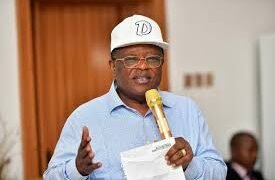







David Umahi, the Minister of Works, has sharply condemned the widespread vandalism of road infrastructure throughout the country. He described these destructive acts against public property as “devilish,” “wicked,” and intolerable.
During a press conference and stakeholders’ engagement centered on the Lagos-Calabar Coastal Highway held on Sunday, he made these remarks. Additionally, at this event, he launched repair work for the Eko and Marine Bridges in Lagos.
Umahi urged Nigerians to assist the government in protecting public infrastructure, emphasizing that it is impossible for the President, ministers, or governors to oversee every national asset by themselves.
He expressed his disappointment, pointing out how troubling it is to witness people putting effort into damaging national assets. If they redirected this energy towards working on the Lagos-Calabar Coastal Highway or other construction projects for state and federal governments, they could achieve more with less effort while earning a better income. “This behavior is sheer malice and completely unacceptable,” he remarked.
He stressed that since the President and governors cannot manage every project individually, joint efforts are essential for safeguarding national assets. “These roads, built during the President’s tenure, should endure for 100 years,” he stated. “However, if they fall victim to vandalism, it takes us back to square one—an outcome we hope to prevent.”
Following the recent vandalism of the newly built Festac-Alakija Bridge, where suspected scavengers allegedly tried to steal embedded iron rods and other metal components, his remarks addressed these events. In response, the Lagos State Government conducted a joint operation with security and enforcement agencies that led to the apprehension of 27 suspects.
Governor Babajide Sanwo-Olu, accompanied by engineers and contractors, conducted an inspection of the damaged sections. He reassured residents that the bridge is safe for use and structurally intact while it continues to accommodate traffic. The governor called for immediate repair work and cautioned those responsible for stealing government property—as well as those buying such items—that they will face legal repercussions.
The minister also voiced concern about unauthorized activities occurring in parts of the Lagos-Calabar Coastal Highway, specifically highlighting issues such as the theft of construction materials and illegal occupancy.
“We have seen people taking out blocks, breaking fences, removing rods, and misusing the highway. This behavior must cease,” Umahi asserted.
He directed the Works Controller in Lagos to ensure that motorcycles, tricycles, hawkers, and other unauthorized activities are prohibited on the coastal highway. “No keke or motorcycles should be allowed on this road; no loitering either—superhighways elsewhere do not have these issues.”
After a late-night meeting with National Assembly members, during which individuals were discovered sleeping on the highway, Umahi emphasized the importance of maintaining order: “There should be no hawking or unauthorized occupancy along the coast.”
He additionally urged the Nigeria Security and Civil Defence Corps to strengthen safeguards for critical national infrastructure, noting that the ministry had requested anti-corruption agencies to evaluate its current projects.
The Lagos-Calabar Coastal Highway is a significant infrastructure project spanning 750 kilometers and featuring ten lanes. Its purpose is to connect Lagos with Cross River, traversing multiple states along the way. Managed by Hitech Construction Company Limited under the oversight of the Federal Ministry of Works, this development seeks to enhance transportation efficiency, alleviate congestion on current roads, and promote economic growth throughout the coastal area.