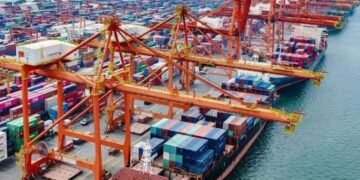








China accounted for 39.27 per cent of Nigeria’s total imports in the first half of 2026, with goods worth N11.01 trillion imported from the Asian country during the six-month period.
The figure represents a significant increase in China’s share of Nigeria’s import market, even as the country’s overall import bill declined compared with the corresponding period of 2025.
An analysis of the latest Foreign Trade in Goods Statistics released by the National Bureau of Statistics showed that Nigeria imported goods worth N5.10 trillion from China in the first quarter of 2026 and another N5.92 trillion in the second quarter.
The combined N11.01 trillion represented 39.27 per cent of Nigeria’s total imports of N28.04 trillion between January and June.
In other words, almost N4 out of every N10 spent by Nigeria on imported goods during the period went to products sourced from China.
The latest figures also show a sharp increase compared with the first half of 2025, when Nigeria imported N9.62 trillion worth of goods from China.
China’s imports rose from N4.66 trillion in the first quarter of 2025 to N4.96 trillion in the second quarter, before climbing further in 2026.
Overall, imports from China increased by N1.39 trillion, representing a 14.49 per cent rise year-on-year.
The increase is particularly significant because Nigeria’s total import bill moved in the opposite direction. Total imports dropped from N33.14 trillion in H1 2025 to N28.04 trillion in H1 2026, a decline of 15.37 per cent.
As a result, China’s share of Nigeria’s imports expanded from 29.03 per cent in the first half of 2025 to 39.27 per cent in H1 2026.
The figures reinforce China’s position as Nigeria’s leading source of imported goods.
In the first quarter of 2026, China supplied N5.10 trillion, accounting for 37.42 per cent of Nigeria’s N13.62 trillion import bill. The United States followed with N2.81 trillion, while India supplied goods valued at N992.87 billion.
China’s dominance became even more pronounced in the second quarter. Its exports to Nigeria increased by 16.09 per cent from the previous quarter to N5.92 trillion, representing 41.02 per cent of the country’s N14.42 trillion imports.
By comparison, the United States supplied N1.01 trillion, or 6.97 per cent, while India accounted for N924.46 billion, representing 6.41 per cent.
The Netherlands and Germany supplied N409.81 billion and N395.87 billion respectively during the quarter.
The Q2 figures meant China supplied nearly six times the value of goods imported from the United States, Nigeria’s second-largest source of imports.
Meanwhile, the rising volume of Chinese imports has coincided with renewed concerns over counterfeit and substandard products entering the Nigerian market.
Public concerns over allegedly fake or adulterated products have grown in recent months, with Nigerians and social media personalities raising questions about items including toothpaste, creams, bottled water and yoghurt drinks.
The National Agency for Food and Drug Administration and Control has also raised concerns about counterfeit networks allegedly linked to Chinese operators.
NAFDAC’s Director of Investigation and Enforcement, Martins Iluyomade, had previously told The PUNCH that the agency had uncovered what it described as a new trend involving some Chinese counterfeiters operating in Nigeria.
The development has added another dimension to the growing trade relationship between Nigeria and China, with authorities facing the challenge of protecting consumers while maintaining legitimate international trade.