


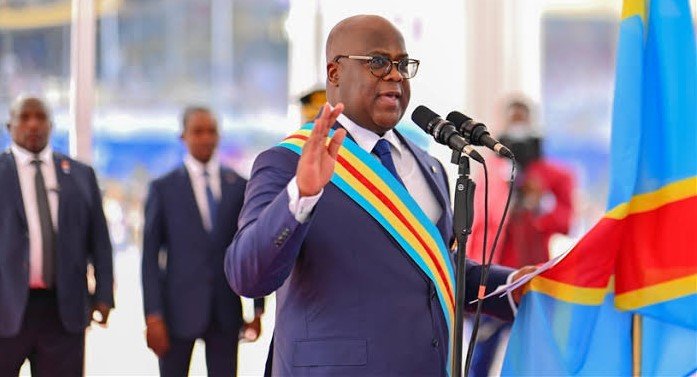
Opposition leaders in the Democratic Republic of Congo (DRC) have resolutely opposed a Constitutional Court decision endorsing a referendum law that could allow President Felix Tshisekedi to pursue a third term.
The opposition coalition, named C64, has characterized the ruling as a grave threat to the nation’s constitutional stability, asserting that it jeopardizes democratic principles and could lead to a constitutional crisis.
During a press conference in Kinshasa, Dieudonné Bolengetenge, Secretary-General of the Together for the Republic party, claimed the court is legitimizing an effort to alter the constitutional structure.

Bolengetenge stated, “The Court’s decision indicates a conspiracy against the constitutional order and paves the way for the Balkanization of the Republic.”
On Tuesday, the Constitutional Court determined that the proposed referendum law aligns with the national constitution, removing a critical legal barrier to potential constitutional amendments under specific exceptional scenarios.
The court noted that the approved measures would permit the President to initiate constitutional changes by forming a constituent assembly, followed by a national referendum in situations of significant governmental dysfunction.
Nonetheless, the judges raised concerns about other aspects of the proposed law, including a clause granting the President authority to call a referendum on issues deemed to have “fundamental” national significance.
President Tshisekedi, who took office in 2019, is in his second five-year term, set to conclude in 2028. The current Constitution prohibits modifications to presidential term lengths and numbers.
Opposition parties contend that the new referendum structure might create a legal avenue for constitutional alterations that could enable Tshisekedi to extend his presidency beyond the existing two-term limit.
The ruling has heightened political tensions in this Central African nation, with critics cautioning that attempts to change term limits may ignite widespread dissent and exacerbate political divisions.
The Congolese government and proponents of the reforms assert that the referendum law aims to bolster governance and provide constitutional means for resolving institutional crises, dismissing claims that it seeks to extend the President’s term.
This controversy is expected to remain a pivotal issue in Congolese politics as the country approaches the end of President Tshisekedi’s second and constitutionally final term based on current laws.