



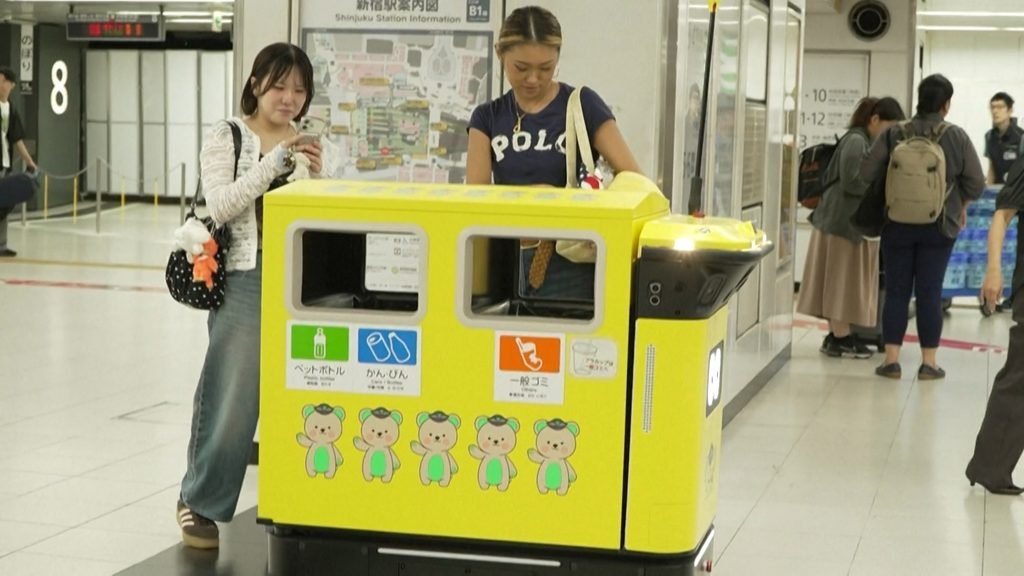
Tokyo’s Shinjuku Station is testing mobile robotic rubbish bins as Japan explores new ways to use automation in busy public spaces.
The trial is being conducted by East Japan Railway Company (JR East), which is assessing whether the robots can help reduce the workload of sanitation workers.
Shinjuku Station is one of the world’s busiest railway stations. Its huge passenger traffic creates a constant demand for waste collection and cleaning.

Robots Designed to Move Around the Station
Unlike conventional rubbish bins, the robotic units are designed to move around rather than remain in a fixed position.
They can travel through parts of the station and collect rubbish where it is needed.
JR East research official Shinya Kawamichi said the company wanted to determine whether the technology could operate safely and effectively in an environment as crowded as Shinjuku.
In some areas of the station, rubbish bins are emptied manually more than 10 times a day.
The frequency highlights the amount of work required to keep the busy transport hub clean.
Japan Turns to Automation
The experiment comes as Japan continues to explore robotics as a response to labour shortages and an ageing population.
Robots are increasingly being considered for repetitive tasks in several sectors, including manufacturing, hospitality and transportation.
At Shinjuku Station, the technology could potentially help sanitation workers spend less time repeatedly checking and emptying bins.
However, the trial also presents significant technical challenges.
Robots Must Navigate Crowds
A railway station is a difficult environment for autonomous machines.
The robots must navigate around commuters, avoid collisions and operate without interfering with the movement of passengers.
They must also be reliable enough to function in a constantly changing environment.
JR East is therefore examining more than the robots’ ability to collect rubbish.
The company will also need to determine how safely and smoothly the machines can operate alongside thousands of passengers.
A Potential New Role for Robots
If the trial proves successful, mobile rubbish bins could become another example of automation being introduced into everyday services in Japan.
The technology could help workers handle repetitive tasks while supporting efforts to maintain cleanliness in crowded transport facilities.
For JR East, the Shinjuku experiment provides an opportunity to examine how robots can work alongside people in one of Tokyo’s most demanding public spaces.